The Republic of Letters and the Letters of the Republic
 The Constitutional Observer
11 min read
The Constitutional Observer
11 min read
A constitutional argument for why the displacement of canonical education from American public schools is not merely a pedagogical error but a structural threat to self-governance
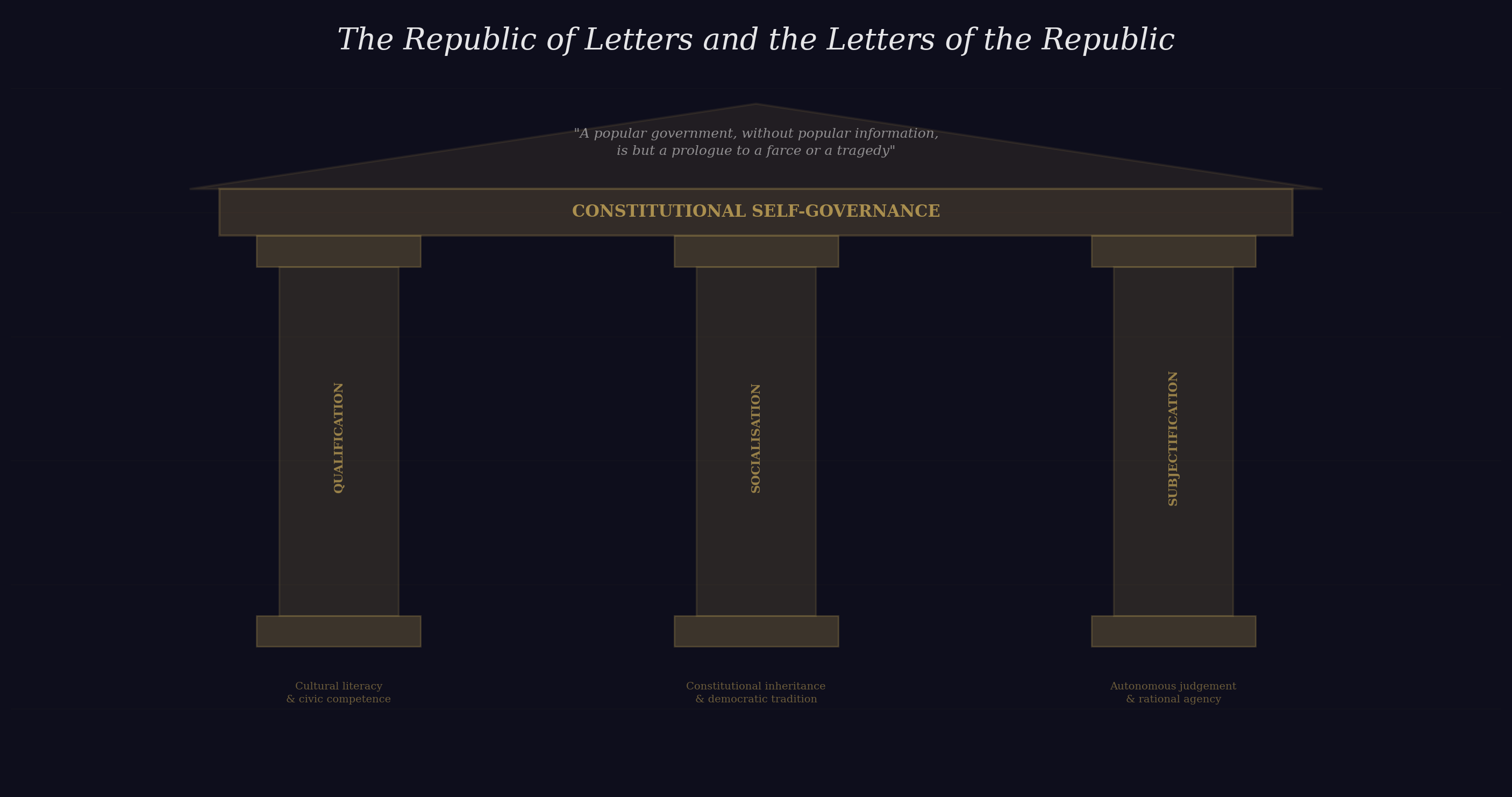
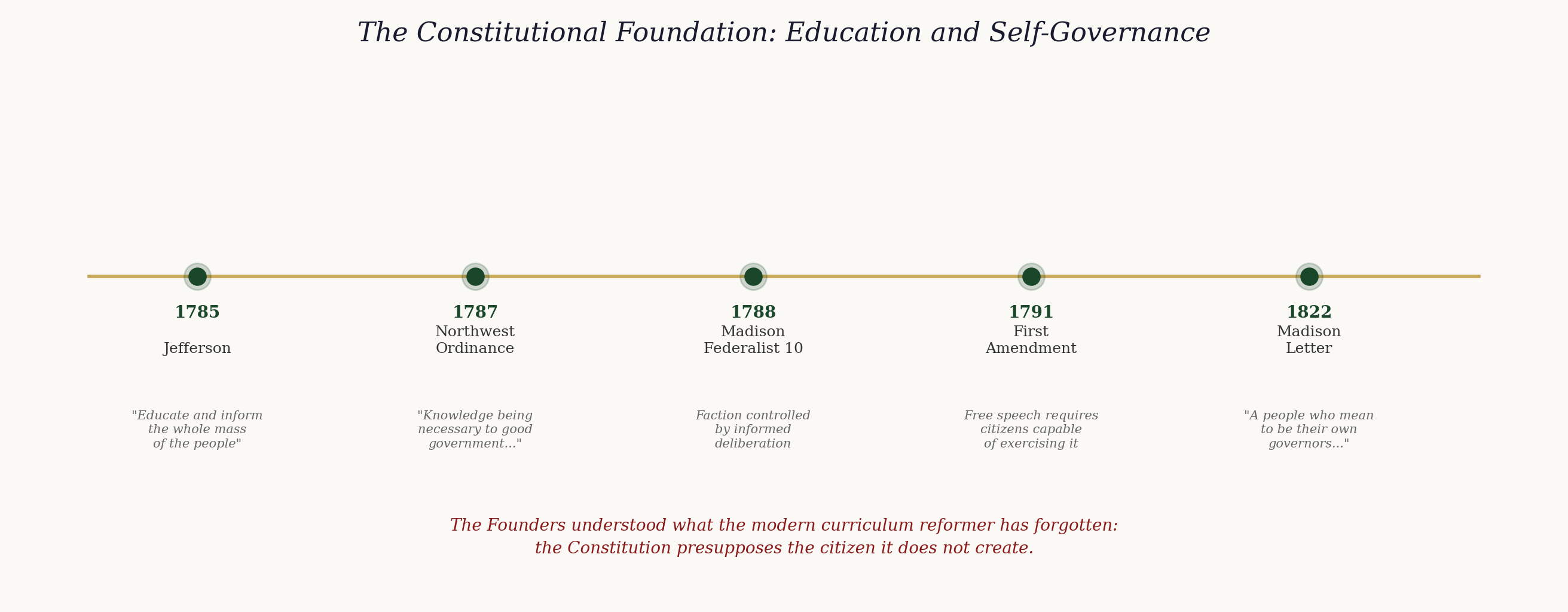
James Madison, in a letter to W. T. Barry dated August 4, 1822, wrote what ought to be inscribed above the entrance to every school of education in America: "A popular government, without popular information, or the means of acquiring it, is but a prologue to a farce or a tragedy; or, perhaps, both." The sentence is not a platitude. It is a constitutional premise. The entire architecture of the American republic — the separation of powers, the Bill of Rights, the electoral franchise, the jury system — presupposes a citizen capable of exercising judgement. The Constitution does not create that citizen. It assumes her. The question of who creates her, and how, and with what materials, is therefore not a question of educational policy alone. It is a question of constitutional infrastructure.
This essay advances a claim that would have been unremarkable to the generation that drafted the Constitution and has become, through a combination of institutional drift and ideological capture, almost unspeakable in contemporary educational discourse: that the displacement of the Western literary and intellectual canon from American public education is not merely a curricular decision but a structural threat to the conditions under which constitutional self-governance is possible. The argument is legal, not nostalgic. It proceeds from the Founders' own understanding of what the republic requires.
The Madisonian Premise
The constitutional case for canonical education does not begin with any amendment. It begins with a structural premise that pervades the entire constitutional design: that the institutions of republican government presuppose an informed, deliberating citizenry, and that without such a citizenry, those institutions cannot function as designed.
Madison's Federalist No. 10 — the most cited of the Federalist Papers and the most sophisticated early treatment of democratic theory in American letters — rests on the proposition that faction is controlled not by suppressing it but by enlarging the sphere of deliberation. The argument works only if the citizens doing the deliberating possess the intellectual equipment to weigh competing claims, identify demagoguery, and reason about the public good from something more substantial than private appetite. Madison's republic is not a republic of impulse. It is a republic of judgement. And judgement, as every lawyer knows, is a trained capacity — not an instinct.
Jefferson was more explicit still. In his 1785 Notes on the State of Virginia, he argued that the purpose of public education was "to diffuse knowledge more generally through the mass of the people," specifying that this knowledge must include "the first elements of morality" and the ability "to read the histories of other ages and nations." The curriculum Jefferson envisaged was not vocational. It was civic. Its purpose was to produce citizens capable of "detecting misrepresentation" and of "exerting their natural powers to defeat" tyrannical designs. Jefferson's citizen is not a passive consumer of information. She is an active participant in the constitutional order — and she becomes that participant through education in the intellectual tradition from which the constitutional order itself emerged.
The Northwest Ordinance of 1787 — enacted by the same Congress that proposed the Constitution — contains a provision whose directness is almost shocking to modern ears: "Religion, morality, and knowledge, being necessary to good government and the happiness of mankind, schools and the means of education shall forever be encouraged." The word "necessary" is not decorative. The Ordinance treats education as a prerequisite of governance — a structural condition without which the constitutional experiment cannot succeed.
These are not isolated sentiments. They represent the settled understanding of the founding generation: that republican self-governance requires citizens equipped with specific intellectual capacities — cultural literacy, historical knowledge, rhetorical competence, the ability to engage with complex argument — and that the state has a structural interest in ensuring those capacities are developed. The question is whether the modern American public school system is fulfilling that structural function, or whether it has been captured by a different set of priorities altogether.
The Displacement and Its Constitutional Significance
Across American public schools, a pattern has consolidated over the past two decades that would alarm any constitutional lawyer who takes the Madisonian premise seriously. Canonical texts — the works that constitute the intellectual inheritance of the civilisation that produced the Constitution — are being progressively displaced from curricula. The displacement is driven not by evidence of superior educational outcomes but by ideological commitments about representation, identity, and the alleged complicity of the Western tradition in structures of oppression.
The movement operates under several labels — "decolonising the curriculum," "disrupting texts," "culturally responsive teaching" — but its operational logic is consistent: canonical works are identified as products of a hegemonic culture, their retention in the curriculum is framed as an act of exclusion, and their replacement with texts selected primarily for the demographic identity of their authors is presented as an act of justice. Shakespeare yields to young adult fiction. The Federalist Papers yield to contemporary memoir. The rhetorical tradition that trained generations of American lawyers, legislators, and citizens yields to a pedagogy of personal relevance.
The constitutional significance of this displacement is not that it offends literary traditionalists. It is that it dismantles the intellectual infrastructure on which constitutional self-governance depends. A citizen who has never encountered the Federalist Papers cannot evaluate the arguments for and against judicial review. A citizen who has never read the Lincoln-Douglas debates cannot distinguish constitutional argument from political sloganeering. A citizen who has never wrestled with the rhetoric of Frederick Douglass — whose 1852 address "What to the Slave is the Fourth of July?" is one of the most devastating deployments of the constitutional tradition against itself — lacks the very instrument with which the tradition's own failures have been most effectively challenged. To remove the tradition is to remove the tools of its critique. The irony is exquisite, and it is lost on those who accomplish it.
Education as Constitutional Infrastructure
The legal argument can be stated with precision. Every state constitution in the United States contains an education clause — a provision requiring the state to establish and maintain a system of public education. These clauses vary in their language, but their structural function is consistent: they impose an affirmative obligation on the state to provide education adequate to the needs of a self-governing citizenry.
The landmark school-finance cases — from Serrano v. Priest in California to Rose v. Council for Better Education in Kentucky — have interpreted these clauses to require not merely the provision of schooling but the provision of an education adequate to enable citizens to participate effectively in democratic life. The Rose decision, in particular, defined an adequate education as one that equips students with, among other things, "sufficient knowledge of economic, social, and political systems to enable the student to make informed choices" and "sufficient grounding in the arts to enable each student to appreciate his or her cultural and historical heritage."
These are not aspirational generalities. They are judicially enforceable standards. And they map directly onto the capacities that canonical education develops: cultural literacy, historical knowledge, rhetorical competence, and the ability to engage with the intellectual tradition from which the constitutional order emerged. A curriculum that displaces the works providing these capacities — and replaces them with texts selected for demographic representativeness rather than intellectual rigour — is a curriculum that may fail to meet the constitutional standard of educational adequacy.
The argument extends to the First Amendment. The Supreme Court has repeatedly recognised that public education serves a constitutional function in preparing students for citizenship. In Board of Education v. Pico (1982), the plurality opinion held that school boards may not remove books from school libraries in a manner that prescribes orthodoxy in matters of opinion. The principle applies with equal force to the affirmative construction of curricula: when canonical texts are removed not because they lack educational merit but because they are deemed ideologically unacceptable — because they represent the "wrong" demographic, or because they are products of a tradition now labelled as oppressive — the removal raises First Amendment concerns about viewpoint discrimination in the educational context.
Keyishian v. Board of Regents (1967) described the classroom as "peculiarly the marketplace of ideas." The metaphor is apt, but it is incomplete. A marketplace requires participants with purchasing power — that is, with the intellectual resources to evaluate what is being offered. A student who has never been exposed to the foundational texts of the constitutional tradition is a participant in the marketplace of ideas who has arrived without currency. She can observe the transaction; she cannot conduct it. The First Amendment protects the marketplace. It does not, by itself, stock it. That is the function of education — and when education fails in that function, the marketplace becomes a place where the rhetorically equipped persuade the rhetorically defenceless. That is not democracy. It is its parody.
The Tinker framework, which recognises that students do not "shed their constitutional rights at the schoolhouse gate," implies a reciprocal obligation: that the schoolhouse itself must provide the intellectual environment in which those rights can be meaningfully exercised. A student who has been educated exclusively in the vocabulary of grievance and identity — who has never encountered the intellectual tradition that produced the concepts of individual rights, due process, and equal protection — is a student whose constitutional rights are formally intact but substantively hollow. The right to speak is of limited value to a citizen who has not been taught the language of constitutional argument.
The Two-Track Republic
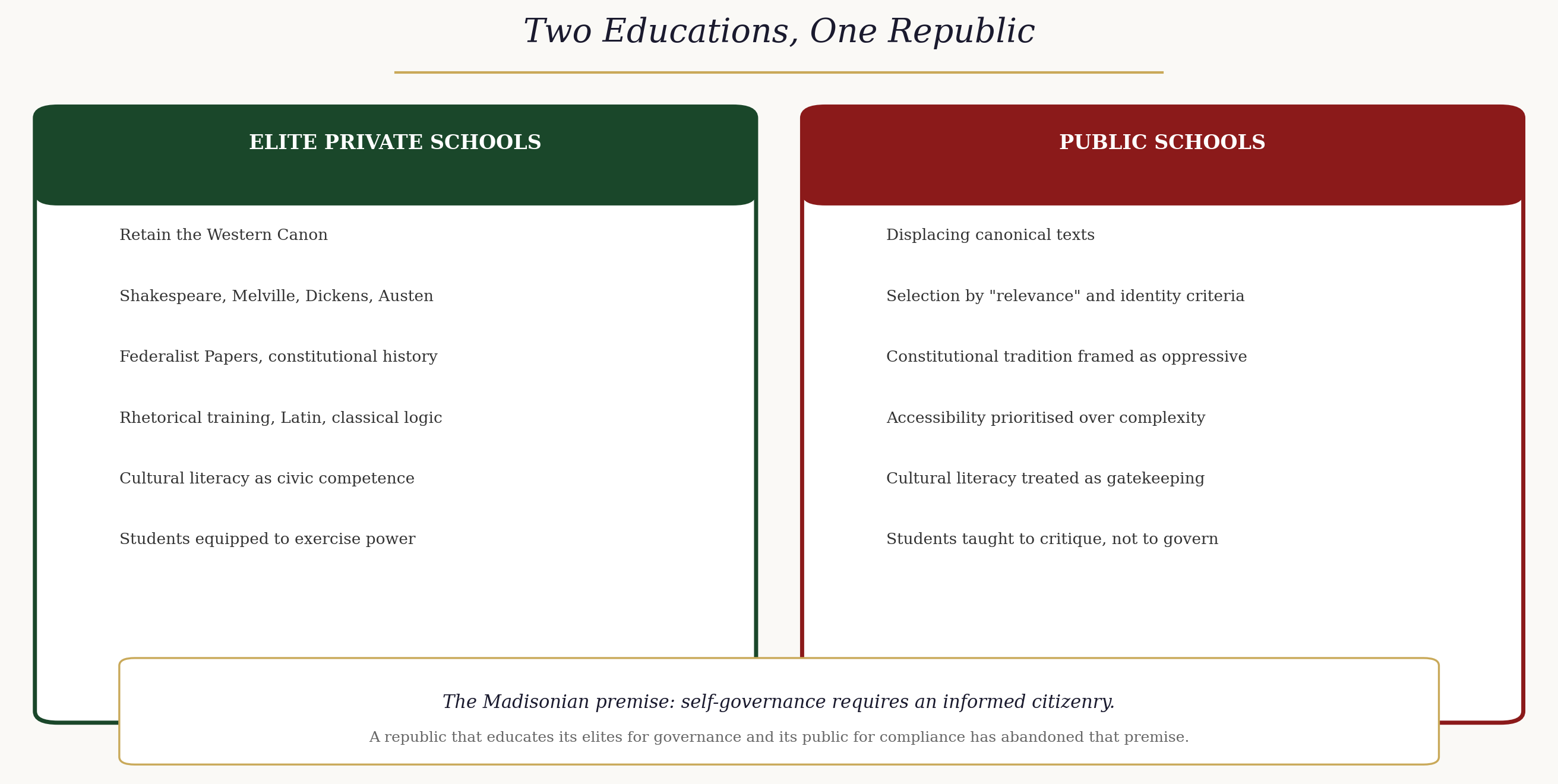
The constitutional concern sharpens when one observes the distribution of canonical education across the American educational landscape. Elite private schools — the Exeters, the Andovers, the Sidwells — retain the Western canon. Their students read Homer, Shakespeare, Locke, Madison, Tocqueville. They are trained in rhetoric, logic, and the close reading of complex texts. They graduate with the cultural literacy and argumentative capacity that the Founders considered prerequisites for participation in republican governance.
Public schools, serving the overwhelming majority of American students, are moving in the opposite direction. Canonical texts are displaced or contextualised into irrelevance. The rhetorical tradition is replaced by "authentic voice" pedagogy. Historical knowledge is subordinated to contemporary relevance. The students who emerge from this system are not less intelligent than their private-school counterparts; they are less equipped. They have been given a different education — one that prepares them for a different role in the constitutional order.
The equal protection implications are difficult to ignore. When the state provides an education to wealthy students that equips them for governance, and a different education to poor students that equips them for compliance, the state has created a two-track citizenship that the Fourteenth Amendment was designed to prevent. The stratification is not achieved through explicit classification — no statute declares that public school students shall receive an inferior civic education — but through the cumulative effect of curricular decisions made by administrators and pedagogical movements insulated from democratic accountability. The result is structural, not intentional. But equal protection doctrine has long recognised that structural effects can constitute constitutional violations, regardless of intent.
The practical consequences are visible in every metric that measures civic participation. Voter turnout, jury service, engagement with local governance, the ability to evaluate campaign rhetoric, the capacity to read and understand a ballot initiative — these are not abstract civic goods. They are the operational requirements of the constitutional system. A citizen who cannot parse the difference between a constitutional argument and a policy preference is a citizen who can be manipulated by anyone who can. The Founders did not design the republic for such citizens. They designed an educational system to prevent them — and that system is being dismantled from within, not by enemies of education but by people who sincerely believe they are improving it.
Madison understood the danger. In Federalist No. 62, he warned that laws should not be "so voluminous that they cannot be read, or so incoherent that they cannot be understood." The principle applies, by obvious extension, to the educational system that produces the citizens who must read and understand those laws. A republic that produces two classes of citizen — one trained to govern and another trained merely to be governed — has not solved the problem of faction. It has institutionalised it.
The Democratic Deficit in Curriculum Governance
The Founders, whatever their disagreements, shared a commitment to the principle that decisions affecting the structure of self-governance must be made through democratic processes. The displacement of canonical education from American public schools has not been made through democratic processes. It has been made through the accumulated decisions of curriculum designers, educational bureaucracies, and activist movements whose accountability runs to institutional hierarchies and professional networks rather than to the communities whose children are being educated.
Parents are not consulted on whether the Federalist Papers should be replaced with contemporary memoir. School boards, where they retain authority over curriculum, are subject to pressure from professional organisations whose ideological commitments may not reflect those of the broader community. The decisions are presented as technical — matters of "best practice" in pedagogy — when they are in fact profoundly political: they determine what kind of citizen the educational system will produce, and therefore what kind of republic those citizens will inhabit.
This is a form of governance failure that constitutional law has the tools to address. The void-for-vagueness doctrine, the non-delegation doctrine, and the substantive due process tradition all share a common concern: that governmental power must be exercised through processes that are transparent, accountable, and subject to democratic control. When curricular decisions with constitutional significance are made by actors who are neither elected nor accountable to the affected communities, the process fails this standard.
The remedy is not judicial micromanagement of reading lists. It is the insistence that curriculum decisions with structural implications for constitutional self-governance must be made through processes that satisfy democratic legitimacy requirements — processes in which parents, communities, and the broader public have a meaningful voice, and in which the burden of proof falls on those advocating displacement to demonstrate that their proposed alternatives produce equivalent or superior civic outcomes. The burden has not been met. It has not, in most cases, even been acknowledged.
The Self-Defeating Logic of Displacement
There is a final irony that constitutional lawyers, of all people, should appreciate. The tradition of rational self-criticism — of subjecting one's own institutions, assumptions, and power structures to rigorous scrutiny — is itself substantially a product of the Western canon that the reformers seek to displace. The very concepts deployed against the tradition — structural inequality, systemic oppression, the critique of power — were forged within it. Douglass used the Constitution against the slaveholders. The suffragists used the language of natural rights against the franchise restrictions. The civil rights movement used the Fourteenth Amendment against the Jim Crow apparatus. In every case, the instrument of critique was drawn from the tradition being critiqued.
To remove the tradition from the curriculum is to remove the intellectual armoury from which future critics will draw. A student who has never encountered the constitutional tradition cannot deploy it against injustice. A student who has been taught that the tradition is merely an instrument of oppression will not recognise it as an instrument of liberation — which is, historically, what it has more often been. The displacement does not empower the marginalised student. It disarms her. And the disarmament is permanent, because the tradition that could have equipped her for the fight has been withheld from her in the name of protecting her from it.
This is the deepest constitutional point. The American republic is not a static inheritance to be received. It is a continuous argument to be conducted — and the argument requires participants who know its terms, its precedents, its rhetorical conventions, and its history. An education that provides these things is not a conservative education. It is a constitutional one. An education that withholds them, however progressive its intentions, is an education that undermines the conditions of its own legitimacy.
Conclusion
The Founders were not sentimentalists about education. They were structural thinkers who understood that institutions depend on the capacities of the people who inhabit them, and that those capacities do not arise spontaneously. Madison's republic requires Madison's citizen — a citizen equipped with cultural literacy, historical knowledge, rhetorical competence, and the ability to engage with complex argument about the public good. The Western canonical tradition is not the only means of producing such a citizen, but it is the tradition from which the constitutional order itself emerged, and its wholesale displacement from public education — without democratic mandate, without evidence of superior civic outcomes, and without acknowledgement of the constitutional stakes — is an act of extraordinary recklessness.
The legal profession, which owes its existence to the constitutional order and whose members are trained in precisely the tradition under attack, has a particular obligation to articulate what is at stake. The displacement of canonical education from American public schools is not a literary question. It is not a pedagogical question. It is a constitutional question — and it deserves the rigour, the seriousness, and the democratic deliberation that constitutional questions demand.
The state education clauses demand adequacy. The First Amendment demands that intellectual life not be subjected to viewpoint orthodoxy. The Fourteenth Amendment demands that the state not maintain a two-track citizenship in which the quality of one's civic education depends on the wealth of one's parents. These are not aspirations. They are legal obligations. And they are being quietly, systematically violated by a curricular revolution that has never submitted itself to the democratic scrutiny that the Constitution requires of decisions with consequences this profound.
A republic that educates its elites for governance and its public for compliance has ceased to be a republic in anything but name. The Founders knew this. It is past time the educational establishment remembered it.