The Executive as Legislature: Constitutional Structure and the Second Trump Administration's Systematic Displacement of Congressional Authority
 The Constitutional Observer
12 min read
The Constitutional Observer
12 min read
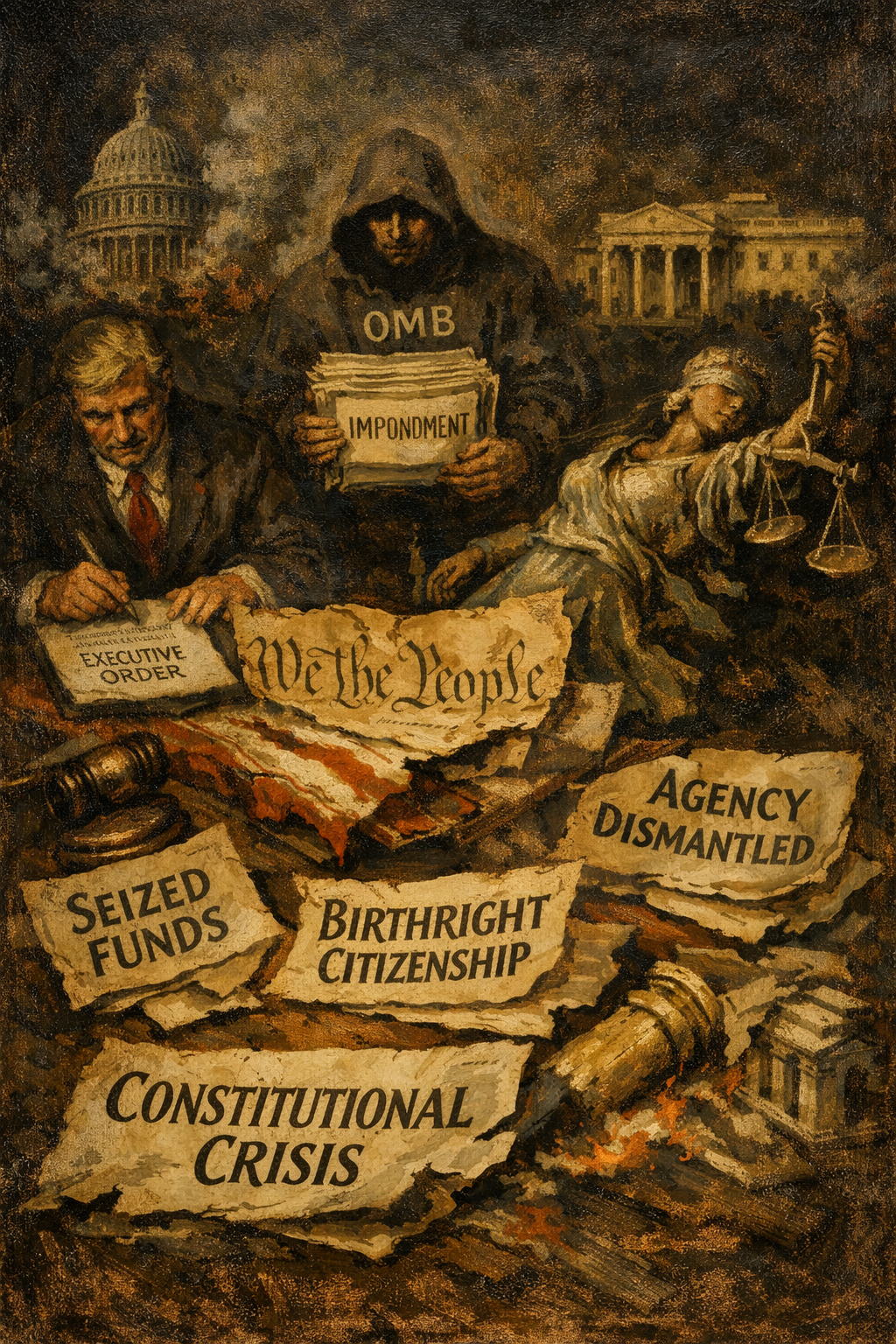
How executive orders, impoundment, and institutional demolition are rewriting the separation of powers without amending the Constitution
By Dr Craig Wright
Constitutional crises do not always announce themselves. They sometimes arrive as administrative memoranda, OMB directives, and executive orders that individually appear to push familiar boundaries but collectively redraw the constitutional map. The second Trump administration has produced such a crisis—not through a single dramatic confrontation with Congress or the courts, but through a sustained, multi-vector programme that systematically relocates fiscal, regulatory, and institutional authority from the legislative branch to the executive. The scale is unprecedented in the modern era: 228 executive orders in the first year alone, 233 active federal lawsuits challenging administration actions as of early 2026, and a pattern of non-compliance with judicial orders that raises questions not merely about the legality of individual policies but about the structural integrity of separated powers itself.1
This analysis identifies and examines five constitutionally distinct dimensions of that programme. Each raises different doctrinal questions. Together, they constitute a de facto revision of the constitutional settlement that no single court order can remedy.
I. Impoundment and the Appropriations Power
The most consequential dimension of the administration's programme—and the one most directly subversive of constitutional structure—is the systematic refusal to spend congressionally appropriated funds. The Appropriations Clause is not a peripheral ornament of the constitutional design. It is the mechanism by which the legislature controls the executive. Article I, Section 9, Clause 7 provides: "No Money shall be drawn from the Treasury, but in Consequence of Appropriations made by Law." The clause does not vest Congress with a recommendation power. It vests Congress with a command power. When Congress appropriates funds for a specified purpose, the executive is constitutionally obligated to expend them.
The doctrinal foundation is settled beyond serious dispute. In Train v. City of New York, 420 U.S. 35 (1975), a unanimous Supreme Court held that the President lacks authority to withhold funds Congress has appropriated under the Federal Water Pollution Control Act Amendments of 1972. The case arose from President Nixon's impoundment of $9 billion in clean-water funding. The Court's holding was categorical: the statute required the Administrator of the EPA to allot the full sums authorised, and the executive had no discretion to withhold them. Every impoundment case decided on the merits during the Nixon era reached the same conclusion. Congress then codified these holdings in the Impoundment Control Act of 1974, Pub. L. No. 93-344, Title X, 88 Stat. 332, which permits the President two narrow options: propose a rescission (requiring affirmative congressional approval within 45 days) or propose a deferral (which Congress may override). What the ICA does not authorise is the unilateral, indefinite withholding of appropriated funds without following either statutory pathway.
The Trump administration has done precisely this, and at scale. Data compiled by the Center on Budget and Policy Priorities indicate that the administration was approximately $26 billion behind the expected pace of 2025 spending commitments through July of that fiscal year.2 The withholdings were not uniformly distributed. They were concentrated in agencies and programmes the administration had proposed to eliminate or drastically reduce in its own budget request: the National Institutes of Health, the Centers for Disease Control, USAID, the Institute of Museum and Library Services, and the Minority Business Development Agency. This pattern provides compelling evidence that the impoundments are policy-motivated—an exercise not of fiscal prudence but of substantive legislative power by the executive branch.
The administration's constitutional argument is that the ICA itself is an unconstitutional infringement on Article II authority. OMB Director Russell Vought and General Counsel Mark Paoletta have argued that the Take Care Clause—which requires the President to "take Care that the Laws be faithfully executed," U.S. Const. art. II, § 3—encompasses a residual power to decline to spend appropriated funds. This argument inverts the constitutional logic. Appropriations statutes are laws. The faithful-execution obligation runs toward compliance with spending mandates, not away from them. As Professor Zachary Price demonstrated in a careful historical analysis in the Stanford Law Review, the overwhelming majority of pre-ICA impoundment examples involved discretionary statutory language or executive actions defended on statutory grounds; they did not assert a preclusive constitutional prerogative to defy spending mandates.3
The administration's "pocket rescission" strategy—deployed in August 2025 against $4.9 billion in USAID funding—deserves particular scrutiny. By submitting a rescission request so late in the fiscal year that the 45-day review period would extend past the September 30 expiration of the appropriation, the administration converted the ICA's congressional-review mechanism into an executive-veto mechanism. The funds were frozen pending review, and the review period outlasted the funds' availability. The GAO has concluded that this manoeuvre is unlawful.4 Senator Susan Collins, the Republican chair of the Senate Appropriations Committee, stated the point plainly: the pocket rescission violates the ICA and Article I of the Constitution.5
The structural analogy is exact. In Clinton v. City of New York, 524 U.S. 417 (1998), the Supreme Court struck down the Line Item Veto Act of 1996 on the ground that it permitted the President to unilaterally amend or repeal portions of duly enacted statutes, in violation of the Presentment Clause. Justice Stevens, writing for a 6-3 majority, held that the cancellations at issue were the functional equivalent of partial repeals of Acts of Congress and that such repeals must conform with Article I. Id. at 438, quoting INS v. Chadha, 462 U.S. 919, 954 (1983). If the President cannot cancel items of appropriation with congressional authorisation, the case for doing so without authorisation—and in defiance of the ICA's procedures—is a fortiori untenable.
II. Birthright Citizenship and the Limits of Executive Reinterpretation
The executive order purporting to end birthright citizenship for children of undocumented immigrants represents a qualitatively different species of constitutional violation. It is not a dispute about the scope of executive discretion within a statutory framework. It is an attempt to override a constitutional provision by executive decree.
The Fourteenth Amendment, Section 1 provides: "All persons born or naturalized in the United States, and subject to the jurisdiction thereof, are citizens of the United States and of the State wherein they reside." The Supreme Court's construction of this clause in United States v. Wong Kim Ark, 169 U.S. 649 (1898), is unambiguous: a child born on American soil to parents who are subject to American jurisdiction—which encompasses all persons present in the territory except for diplomats and hostile occupying forces—is a citizen by birth. This holding has been continuously applied for over 125 years and has never been modified or overruled.
The administration's theory—that "subject to the jurisdiction thereof" was originally understood to apply only to formerly enslaved persons—is historically and doctrinally untenable. The text contains no such limitation, and the Wong Kim Ark Court considered and rejected precisely this narrow construction. Four federal judges have now blocked the executive order on the ground that it is likely unconstitutional, and the case is expected before the Supreme Court in 2026 as Trump v. Barbara.6
The structural principle at stake transcends immigration policy. If the President can unilaterally reinterpret a constitutional provision to exclude a class of persons from its protection—without amendment under Article V, without legislation, without judicial construction—then constitutional rights are not rights at all. They are executive permissions, revocable at the discretion of whoever occupies the office. The Fourteenth Amendment was ratified specifically to prevent this: to place fundamental guarantees beyond the reach of ordinary political majorities and, a fortiori, beyond the reach of the executive alone.
III. Institutional Demolition: DOGE and the Statutory Agency Problem
The Department of Government Efficiency operated as an executive initiative directed by Elon Musk—a "special government employee" with no statutory authorisation, no Senate confirmation, and no clear legal basis for much of what the initiative undertook. DOGE personnel accessed Treasury payment systems and sensitive personnel databases, terminated government contracts, and facilitated the elimination of approximately 212,000 federal positions. The effective dismantlement of USAID—83 per cent of its programmes eliminated within six weeks—was carried out under DOGE direction.7
The constitutional problem is straightforward. Federal agencies exist because Congress legislated them into existence and appropriated funds for their operation. The Department of Education was established by the Department of Education Organization Act, Pub. L. No. 96-88, 93 Stat. 668 (1979). USAID operates under the Foreign Assistance Act of 1961, Pub. L. No. 87-195, 75 Stat. 424. The Voice of America is authorised by the U.S. International Broadcasting Act of 1994. The President cannot eliminate a statutory agency by executive order any more than he can repeal a statute by proclamation. The distinction between prosecutorial discretion—a recognised executive prerogative within limits—and institutional demolition—which is legislative repeal by other means—is the distinction between executing the law and nullifying it.
Federal courts have intervened repeatedly. Judges have ordered the reinstatement of fired employees, the continued funding of Voice of America, and the restoration of frozen grants. The administration's compliance has been partial and grudging, prompting contempt proceedings in several jurisdictions.8 But the structural damage does not wait for final adjudication. When an agency's workforce is gutted, its institutional knowledge destroyed, its contracts terminated, and its operational capacity dismantled, a subsequent court order to "restore" the agency confronts an irreversibility problem. The executive has created facts on the ground that judicial remedies cannot fully undo. The court can order restoration; it cannot order the return of the personnel who resigned, the contractors who moved on, or the institutional memory that was deleted. Congress itself largely rejected the administration's proposed cuts—of 30 programmes Trump proposed to slash or eliminate, only one was eliminated by Congress, and only two were cut by more than half.9 The executive achieved through administrative demolition what it could not achieve through the legislative process.
IV. Independent Agencies and the Unitary Executive
Executive Order 14215, "Ensuring Accountability for All Agencies," extends direct presidential control over independent regulatory agencies—entities Congress deliberately insulated from executive command through for-cause removal protections, staggered terms, and bipartisan composition requirements. The Federal Election Commission, the Federal Reserve, and the Securities and Exchange Commission were structured this way because Congress determined that their functions require independence from the political preferences of the incumbent president.
The administration's theory draws on the "unitary executive" doctrine—the position that all executive power is vested in the President and that structural limitations on presidential control of executive officers are constitutionally suspect. The Supreme Court's recent jurisprudence on removal power provides some doctrinal support. But even the strongest version of the unitary executive doctrine does not authorise the President to direct the substantive decisions of agencies whose independence is mandated by statute. There is a constitutionally significant difference between the power to remove an officer and the power to dictate an agency's regulatory output. The former is a personnel question; the latter is a legislative question, because the agency's mandate, jurisdiction, and decisional criteria are established by statute, not by executive preference. The Fourth Circuit's February 2026 decision in Nat'l Ass'n of Diversity Officers in Higher Education v. Trump, No. 25-1189, vacating a preliminary injunction against two DEI-related executive orders, illustrates the judicial terrain: courts are willing to grant the executive considerable latitude on facial challenges while reserving judgement on as-applied questions—a posture that permits significant executive action to proceed while the constitutional questions remain formally open.10
The practical stakes are immediate. If the President can direct the Federal Election Commission's enforcement priorities, then the body responsible for enforcing campaign-finance law operates at the pleasure of the person most likely to benefit from its non-enforcement. The separation-of-powers concern is not abstract. It is structural and self-interested simultaneously—a combination the Framers regarded as the paradigm case requiring institutional constraint.
V. Emergency Powers and the Election Apparatus
A draft executive order circulated on 13 March 2026 would federalise aspects of the election process during declared national emergencies.11 The constitutional allocation of election administration is explicit. Article I, Section 4 provides: "The Times, Places and Manner of holding Elections for Senators and Representatives, shall be prescribed in each State by the Legislature thereof; though the Congress may at any time by Law make or alter such Regulations." The President is absent from this architecture. The electoral process is the domain where the Framers were most deliberate in excluding executive control, for the manifest reason that the incumbent has a direct personal interest in the outcome of elections.
The draft order exploits the open-ended character of emergency declarations to claim authority over a function the Constitution assigns to the states and Congress exclusively. If the President can federalise elections by declaring an emergency—and the President defines what constitutes an emergency—then the constraint is self-cancelling. An earlier executive order already directed the Election Assistance Commission to require documentary proof of citizenship for voter registration and threatened to withhold federal funding from non-compliant states—actions that a federal court temporarily blocked in California v. Trump, No. 25-cv-10810 (D. Mass.), on the ground that the order violated the Elections Clause and separation-of-powers principles.12
VI. The Structural Pattern and the Deeper Failure
These five vectors are not independent policy disputes. They are components of a unified structural pattern: the displacement of legislative authority by executive action, implemented through legal theories that share a common premise—that Article II vests the President with a residual sovereignty overriding the specific textual allocations of power to Congress and the states. This premise is constitutionally unfounded. The Constitution does not establish a default executive sovereignty. It establishes a government of enumerated and separated powers in which the legislature is the primary lawmaking institution.
The pattern matters because winning individual lawsuits does not solve the structural problem. The administration has lost repeatedly in the lower federal courts. Yet the policy objectives are frequently achieved before the courts can act, or despite judicial orders incompletely obeyed. The Supreme Court, with its 6-3 conservative majority, has frequently stayed lower-court injunctions, producing a de facto regime in which probably unlawful policies operate for extended periods before final adjudication. The emergency-stay docket has become the mechanism by which executive overreach is normalised: not vindicated on the merits, but permitted to continue pending a resolution that may never arrive.
The Framers designed separated powers not because they trusted the branches to cooperate, but because they expected them to compete. Madison's argument in Federalist No. 51 is explicit: "Ambition must be made to counteract ambition." The system depends on each branch defending its own prerogatives. The judiciary has performed this function, with the temporal limitations inherent in litigation. The legislature has not. When Congress declines to enforce the Impoundment Control Act; when the Senate declines to assert its confirmation prerogatives over DOGE personnel exercising executive power without confirmation; when the legislature permits its appropriations to be nullified by administrative inaction—the constitutional structure is not merely weakened. It is affirmatively surrendered by the branch that holds it.
The question is not whether any individual executive order is lawful. Many plainly are not. The question is whether the constitutional structure that constrains executive power survives as a functioning system of separated powers or degrades into a set of norms the executive observes when convenient and disregards when not. The administration's programme is best understood as a systematic effort to establish precedents that permanently enlarge the executive's share of governmental power. Each individual action may be reversed. The structural precedent—that the executive can withhold appropriated funds, reinterpret constitutional provisions, dismantle statutory agencies, direct independent regulators, and federalise elections, without legislative authorisation—is considerably harder to undo. Precedent established through acquiescence becomes the baseline for the next administration, and the next, regardless of party.
That is the constitutional crisis. Not a dramatic confrontation, but a quiet ratchet—each turn tightening the executive's grip on powers the Constitution assigns elsewhere, each turn made possible by the failure of the institution holding the countervailing authority to use it.
Notes
1 Just Security, "Litigation Tracker: Legal Challenges to Trump Administration Actions" (updated 16 January 2026), available at https://www.justsecurity.org/107087/tracker-litigation-legal-challenges-trump-administration/; States United Democracy Center, "Executive (Dis)Order: Trump's Unprecedented Use of Executive Orders and How States Are Fighting Back" (2 December 2025) (reporting 228 executive orders through 12 January 2026).
2 Center on Budget and Policy Priorities, "New Data Show Trump Administration's Illegal, Targeted Withholding of Funds" (26 September 2025), available at https://www.cbpp.org/research/federal-budget/new-data-show-trump-administrations-illegal-targeted-withholding-of-funds.
3 Zachary S. Price, "Trumpian Impoundments in Historical Perspective," Stanford Law Review Online (23 July 2025). See also Matthew B. Lawrence, Eloise Pasachoff & Zachary S. Price, "Appropriations Presidentialism," 114 Geo. L.J. Online (forthcoming 2025).
4 Center on Budget and Policy Priorities, "Many Trump Administration Fiscal and Regulatory Actions Are Unlawful" (11 February 2025), available at https://www.cbpp.org/research/federal-budget/many-trump-administration-fiscal-and-regulatory-actions-are-unlawful.
5 Government Executive, "Trump moves to unilaterally withhold funds, drawing bipartisan calls of illegality" (29 August 2025) (quoting Senator Collins: "GAO has concluded that this type of rescission is unlawful and not permitted by the Impoundment Control Act").
6 Axios, "How Trump's agenda lands at the Supreme Court in 2026" (1 January 2026); see also Rep. Steve Cohen, "Tracking the Trump Administration's Harmful Executive Actions" (updated 2025) (noting four federal judges have blocked the birthright-citizenship order).
7 CNN, "How Trump upended the federal government in 2025" (1 January 2026) (reporting approximately 212,000 federal job losses); Rep. Steve Cohen, supra note 6 (noting 83% of USAID programmes eliminated).
8 Bloomberg Law, "Trump's DOJ Losing Court Fights Over DOGE, Musk Secrecy" (24 February 2026).
9 Washington Times, "DOGE defeat: Congress has rejected most of Trump's spending cuts" (19 February 2026) (sampling 30 programmes targeted for elimination; only one eliminated by Congress).
10 Nat'l Ass'n of Diversity Officers in Higher Educ. v. Trump, No. 25-1189, 2026 WL 321433 (4th Cir. Feb. 6, 2026).
11 Washington Today, "Legal Scholars Warn of Constitutional Dangers in Trump's National Emergency Election Plan" (13 March 2026). Note: this draft order has been reported by a single source; independent corroboration is advisable.
12 States United Democracy Center, supra note 1 (describing California v. Trump, No. 25-cv-10810 (D. Mass.), and the 13 June 2025 order temporarily blocking key provisions of the election-administration executive order).
Cases Cited
Clinton v. City of New York, 524 U.S. 417 (1998).
INS v. Chadha, 462 U.S. 919 (1983).
Train v. City of New York, 420 U.S. 35 (1975).
United States v. Wong Kim Ark, 169 U.S. 649 (1898).
California v. Trump, No. 25-cv-10810 (D. Mass. 2025).
Nat'l Ass'n of Diversity Officers in Higher Educ. v. Trump, No. 25-1189 (4th Cir. 2026).
Statutes Cited
U.S. Const. art. I, § 4 (Elections Clause).
U.S. Const. art. I, § 9, cl. 7 (Appropriations Clause).
U.S. Const. art. II, § 3 (Take Care Clause).
U.S. Const. amend. XIV, § 1 (Citizenship Clause).
Impoundment Control Act of 1974, Pub. L. No. 93-344, Title X, 88 Stat. 332.
Line Item Veto Act of 1996, Pub. L. No. 104-130, 110 Stat. 1200.
Department of Education Organization Act, Pub. L. No. 96-88, 93 Stat. 668 (1979).
Foreign Assistance Act of 1961, Pub. L. No. 87-195, 75 Stat. 424.