The Constitution and the Protocol: Commerce, Due Process, and the Contract Nobody Noticed
 The Constitutional Observer
16 min read
The Constitutional Observer
16 min read
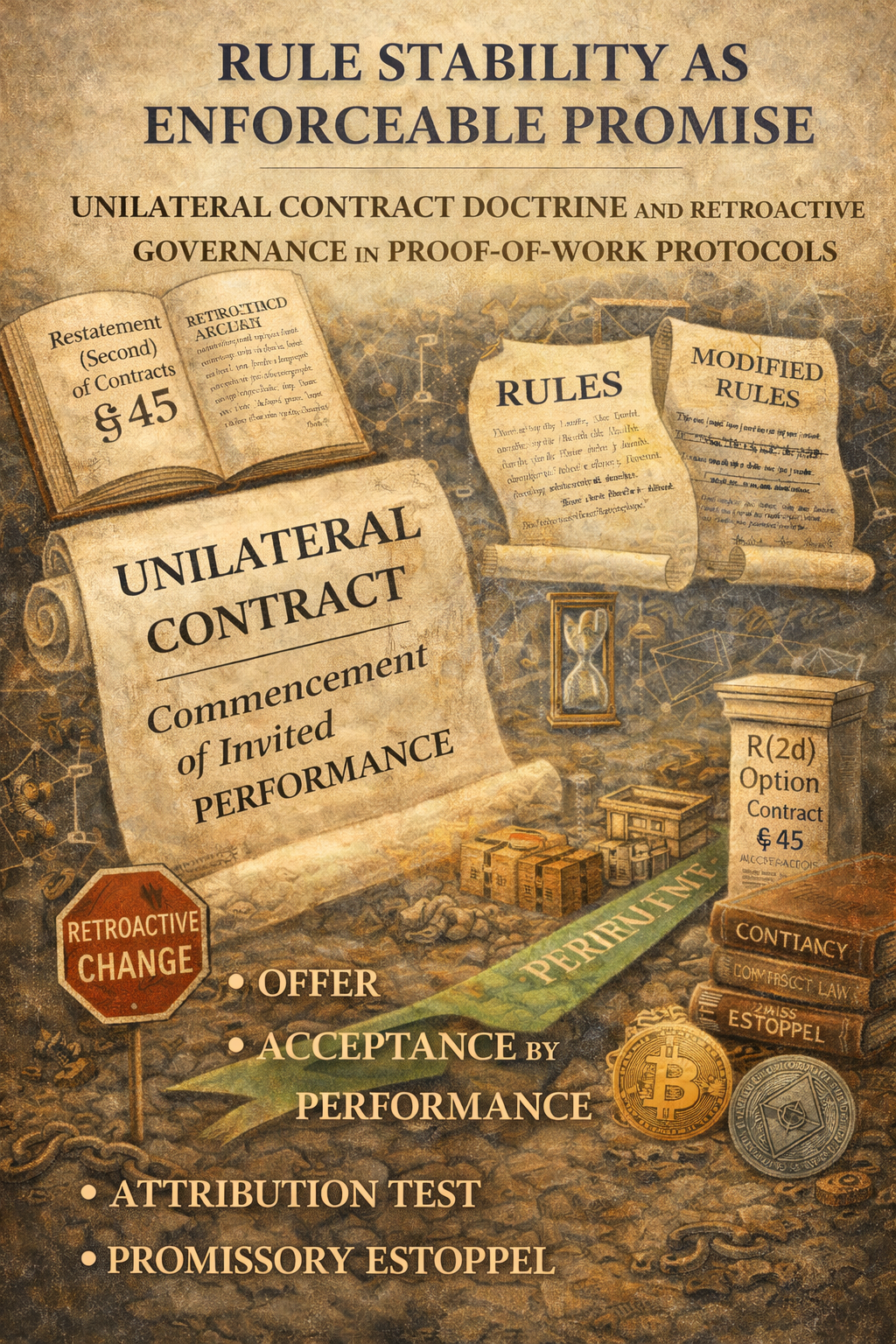
In which we discover that proof-of-work mining has been creating enforceable contracts under everyone's nose, that those contracts are property, and that the Commerce Clause, the Due Process Clause, the Contracts Clause, and the Takings Clause have been patiently waiting for someone to notice.
There is a particular flavour of civilisational embarrassment that occurs when an entire legal community fails to see what is directly in front of it. Not because the thing is hidden. Not because the doctrine is obscure. But because a collective failure of imagination has caused everyone to assume that a new technology must require new law—when in fact the old law was already there, fully operative, waiting only for someone with the intellectual composure to apply it.
The constitutional law of protocol governance is such an embarrassment. For over a decade, scholars, regulators, and jurists have debated whether tokens are securities, whether miners are money transmitters, whether decentralised autonomous organisations are general partnerships—and in all that time, almost no one has asked the logically prior question: What is the legal character of the relationship between the entity that publishes a proof-of-work protocol specification and the person who expends resources to satisfy it?
The answer, once stated, is so orthodox as to be almost boring. It is a unilateral contract. The specification is an offer. The expenditure of computational resources is performance. Commencement of that performance triggers the Restatement (Second) of Contracts §45 option-contract constraint. And the enforceable promise is not payment—block rewards are endogenous system states that no defendant controls—but rule stability: the commitment that the published terms will not be retroactively altered to defeat performance already underway.
That contractual relationship is the keystone. Without it, constitutional law has nothing to grip. With it, four provisions of the United States Constitution activate simultaneously—and the consequences for state regulation, federal authority, and the global governance of proof-of-work systems are, to indulge in a moment of understatement, considerable.
I. The Contract That Creates the Constitution's Interest
Before the Commerce Clause can protect commerce, there must be commerce. Before the Due Process Clause can protect property, there must be property. Before the Contracts Clause can prevent impairment, there must be a contract to impair. Before the Takings Clause can require compensation, there must be something to take. Constitutional protections do not hover in the ether, looking for occasions to attach. They require a factual and legal predicate. In the case of protocol governance, that predicate is contractual—and the failure to identify it has left the entire constitutional analysis of blockchain regulation without a foundation.
A proof-of-work protocol publishes a standing set of rules. Those rules invite a defined act: the expenditure of computational resources to assemble a valid block, satisfy a difficulty threshold, and broadcast the result. The rules specify what counts as valid performance, what reward attaches, and what conditions must be met before the reward matures. Participants expend real resources—electricity, hardware depreciation, opportunity cost—to satisfy these published conditions. They do not promise to perform; they incur no liability for stopping. The structure is not a bilateral exchange of promises. It is a public offer inviting acceptance by costly performance.
This is the structure of a unilateral contract. The doctrine is ancient and uncontroversial. Public-offer cases from Carlill v. Carbolic Smoke Ball Co. [1893] 1 QB 256 through the American reward-offer authorities establish that where a public communication is clear, definite, and explicit, and leaves nothing open for negotiation, it constitutes an enforceable offer that cannot be defeated by post hoc conditions. Cobaugh v. Klick-Lewis, Inc., 561 A.2d 1248 (Pa. Super. 1989), enforced a golf tournament prize offer against the sponsor. Broadnax v. Ledbetter, 99 S.W. 1111 (Tex. 1907), enforced a reward offer against a public authority. The principle is settled: a public offer inviting acceptance by performance, accepted by performance, creates an enforceable obligation.
The critical doctrinal mechanism is §45 of the Restatement (Second). Where an offer invites acceptance by performance rather than by return promise, the beginning of the invited performance creates an option contract that constrains the offeror's power to revoke. The offeror's duty to pay remains conditional on completion—§45(2) preserves the performance condition—but the offeror cannot withdraw the offer while the offeree completes. Marchiondo v. Scheck, 78 N.M. 440 (1967), operationalised the test: what constitutes commencement depends on the specific offer and what can be done toward performance within its terms. Ever-Tite Roofing Corp. v. Green, 83 So.2d 449 (La. Ct. App. 1955), extended the principle: loading trucks and proceeding to a job site constitutes commencement that constrains revocation.
In proof-of-work mining, commencement is the initiation of directed computational work under a specific specification for a specific block interval. Preparatory acts—acquiring hardware, installing software, securing power contracts—are analogous to studying the market before making a bid: necessary but not yet performance. Commencement occurs when the participant begins computing hash solutions directed at the current block under the current rules. The evidence is administrable: software version, configuration files, pool membership records, network participation signals, timestamped computation logs.
Now: who is the offeror? The question is harder than it sounds, because protocol governance structures vary. But the answer follows a hierarchy that maps onto established agency and partnership doctrine. Where an identifiable entity—a foundation, a corporation, a funded development team—authors the specification, controls the code repository, and holds itself out as the source of operative terms, that entity is the offeror under orthodox agency principles. The Ethereum Foundation, which controlled the go-ethereum repository and coordinated the 2016 DAO hard fork, satisfies this test with room to spare. Where no single entity controls publication but an identifiable group collaborates, partnership or joint venture doctrine under the Revised Uniform Partnership Act §202 may apply. Where governance is genuinely diffuse and no identifiable publisher exists, no contract claim lies. The limiting principle is built in: no identifiable offeror, no claim. That is a feature, not a defect.
And the enforceable promise? Not payment. The block reward is a protocol-endogenous state—a computational output, not a disbursement from anyone's treasury. No defendant can guarantee that the network will recognise a particular block. But what the governance actor does control is the specification itself: the criteria defining valid performance, completion conditions, and reward entitlement. The promise is rule stability: having published specifications under which performers commenced costly work, the governance actor will not retroactively alter those specifications to defeat what would otherwise count as valid performance under the terms in force at commencement.
This promise is wholly within the governance actor's power, because the governance actor controls publication. A commitment not to retroactively alter a specification one controls is as straightforwardly within one's capacity as a contest sponsor's promise not to change judging criteria after entries are submitted.
That is the contractual predicate. Now watch what happens when we hand it to the Constitution.
II. The Commerce Clause: Mining Is Commerce, and the Commerce Is Global
Article I, Section 8, Clause 3 grants Congress the power "to regulate Commerce with foreign Nations, and among the several States." The clause operates in two dimensions: affirmatively, as a grant of federal regulatory authority; and negatively—the dormant Commerce Clause—as a constraint on state regulations that discriminate against or unduly burden interstate and foreign commerce.
The factual substrate is unambiguous. Proof-of-work mining is commercial activity with interstate and international dimensions so extensive that characterising it as anything other than "commerce among the several States" and "with foreign Nations" would require a Commerce Clause jurisprudence that does not exist. Miners in Texas satisfy specifications published in Switzerland. Transactions validated in those blocks involve parties across dozens of jurisdictions. Electricity is purchased from state-regulated utilities. Hardware is imported under federal tariff schedules and depreciated under the Internal Revenue Code. Tokens are traded on exchanges subject to federal securities and commodities regulation.
The Supreme Court's aggregation principle from Wickard v. Filburn, 317 U.S. 111 (1942)—sustained federal authority over a farmer growing wheat for personal consumption—would sustain authority here without breaking a sweat. Gonzales v. Raich, 545 U.S. 1 (2005), extended the principle to locally grown marijuana that never crossed state lines. If home-grown wheat and backyard cannabis are interstate commerce, then global proof-of-work mining conducted across continents, consuming industrial quantities of electricity, and producing assets traded on international exchanges is interstate commerce a fortiori.
The Dormant Dimension
The more immediately consequential application is the dormant Commerce Clause constraint on state regulation. New York's 2022 moratorium on certain proof-of-work mining operations (N.Y. Laws ch. 814) is the paradigm case. The moratorium imposed a two-year prohibition on new permits for fossil-fuel-powered proof-of-work mining facilities. Whatever its environmental merits, it operates as a direct regulation of the performance side of the unilateral contract: the expenditure of computational resources to satisfy published specifications.
Under Pike v. Bruce Church, Inc., 397 U.S. 137 (1970), a state regulation that burdens interstate commerce is invalid unless it serves a legitimate local purpose and the burden imposed on interstate commerce is not "clearly excessive in relation to the putative local benefits." The Pike balancing here is unfavourable to the state. Proof-of-work mining is a globally competitive activity in which location is a function of electricity cost, regulatory environment, and network latency. State regulations that prohibit mining within one jurisdiction do not reduce global mining. They relocate it—potentially to jurisdictions with less stringent environmental standards, producing the perverse result of increasing aggregate environmental harm while burdening interstate commerce.
The contractual predicate sharpens the analysis. Without it, the miner is merely a speculator whose activity the state has restricted—a sympathetic but legally weak position. With it, the miner is a party to an enforceable contract whose performance the state has prohibited. The burden on interstate commerce is not merely the displacement of economic activity; it is the state's interference with contractual relationships that are inherently interstate and international in character. A miner who has commenced performance under a published specification—who has triggered the §45 constraint—and is then prohibited by state law from completing that performance has suffered a legally cognisable injury that the dormant Commerce Clause was designed to prevent.
The Foreign Commerce Clause: The Uniformity Imperative
The analysis becomes most acute in the international dimension. The Foreign Commerce Clause—the same textual provision applied to commerce "with foreign Nations"—imposes a stricter uniformity requirement.
In Japan Line, Ltd. v. County of Los Angeles, 441 U.S. 434 (1979), the Supreme Court held that state regulations affecting foreign commerce must not create a substantial risk of multiple taxation by different sovereigns and must not prevent the federal government from "speaking with one voice" in regulating commercial relations with foreign nations. Barclays Bank PLC v. Franchise Tax Board, 512 U.S. 298 (1994), refined the analysis but preserved the core principle: state regulation of foreign commerce is constitutionally suspect where it threatens international regulatory uniformity.
Protocol governance is, by its structural nature, foreign commerce. The Ethereum Foundation is domiciled in Zug, Switzerland. Bitcoin Core's maintainers span multiple countries. Mining operations cover every continent with reliable electricity. The contractual relationships between governance actors and performers cross national boundaries as a defining feature, not an incidental consequence. A specification published in Switzerland is performed upon in Texas, Kazakhstan, and Paraguay simultaneously.
If New York imposes one regulatory regime on these contractual relationships, Texas another, and Wyoming a third, the result is a patchwork of inconsistent state-level constraints on commerce that the Constitution allocates to federal authority. The "one voice" requirement of Japan Line demands federal uniformity—not because mining is technologically special, but because the commerce it constitutes is foreign. State-level regulation of the contractual dimension of protocol governance—the offer-acceptance-performance structure, the stability of specifications, the conditions under which retroactive changes are permissible—is constitutionally suspect under the Foreign Commerce Clause.
III. Due Process: When Government Mandates Retroactivity
The Fifth Amendment prohibits the federal government from depriving any person of "life, liberty, or property, without due process of law." The Fourteenth Amendment extends the prohibition to the states. Both contain a substantive component that constrains retroactive governmental action.
The connection requires one additional step: state action. The Due Process Clauses constrain governmental actors, not private parties. A foundation's retroactive specification change is a breach of contract—a private wrong remediable at common law. The constitutional dimension emerges only when the state becomes entangled with the governance decision.
That entanglement is not hypothetical. In August 2022, the Treasury Department's Office of Foreign Assets Control sanctioned the Tornado Cash smart contracts, effectively requiring Ethereum validators to exclude sanctioned addresses from blocks. The practical consequence was a specification-level constraint imposed by governmental action: performers who had commenced work under specifications that did not exclude sanctioned transactions were required, by force of federal law, to alter their performance criteria. If OFAC sanctions mandate protocol-level changes that retroactively affect commenced performance, the governmental action is present and the Due Process analysis is triggered.
The Supreme Court's decision in Eastern Enterprises v. Apfel, 525 U.S. 498 (1998), is directly on point. The plurality held that a federal statute imposing retroactive liability on a former coal company for miners' health benefits was unconstitutional under the Takings Clause; Justice Kennedy, concurring in the judgment, reached the same result under substantive due process. The critical principle: retroactive economic legislation that imposes severe and disproportionate burdens based on conduct that was lawful and complete at the time it occurred violates due process.
The parallel is exact. A miner who commenced performance under lawful specifications and is subsequently required by governmental mandate to abandon that performance—or to comply with retroactively altered criteria—has been subjected to precisely the species of retroactive burden that Eastern Enterprises condemns. The performer's reliance expenditure—electricity consumed, hardware depreciated, opportunity costs incurred—is irrecoverable. The governmental mandate destroys the value of commenced performance without procedural safeguards adequate to the deprivation.
The proportionality inquiry of BMW of North America, Inc. v. Gore, 517 U.S. 559 (1996), supplies an additional constraint. Where governmental action mandates protocol changes that destroy millions of dollars in commenced mining performance, the due process requirement of proportionality limits the government's ability to impose retroactive burdens without adequate justification. The government may regulate prospectively—it may require that future specifications comply with sanctions, environmental standards, or other legitimate regulatory objectives. What it may not do, consistent with due process, is retroactively destroy the value of performance already commenced under lawful terms.
IV. The Contracts Clause: State-Mandated Impairment
Article I, Section 10 provides: "No State shall... pass any... Law impairing the Obligation of Contracts." This was, for the Framers, among the most consequential structural constraints on state power—a direct response to the post-Revolutionary debtor-relief legislation that had shattered commercial confidence under the Articles of Confederation. Madison, in Federalist No. 44, described laws impairing contractual obligations as "contrary to the first principles of the social compact, and to every principle of sound legislation."
The Contracts Clause has been waiting for the contractual predicate. Without it, there is no obligation to impair, and the clause is doctrinally irrelevant to blockchain regulation. With it, the clause becomes the most potent constitutional constraint on state-level protocol governance.
The modern analysis, established in Energy Reserves Group, Inc. v. Kansas Power & Light Co., 459 U.S. 400 (1983), asks three questions: (1) whether the state law substantially impairs a contractual relationship; (2) whether the state has a significant and legitimate public purpose; and (3) whether the adjustment of rights and responsibilities is reasonable and appropriate to that purpose.
Consider a state that mandates compliance with a particular protocol specification—requiring miners operating within the state to adopt a new specification that retroactively invalidates blocks mined under the prior version. Under the unilateral contract analysis, those miners hold §45 option contracts protecting their commenced performance. The state mandate impairs those contracts by compelling retroactive alteration of the specifications under which performers commenced work. Under Energy Reserves, the state must demonstrate a legitimate public purpose and a reasonable adjustment of rights. Environmental protection, sanctions compliance, or financial stability may supply the purpose—but the "reasonable adjustment" inquiry demands that the state account for the reliance interests the contractual framework identifies. A blanket retroactive mandate that destroys all commenced performance within the state without notice, transition periods, or compensation for vested contractual interests is unlikely to survive scrutiny.
The Contracts Clause analysis becomes particularly devastating when combined with the Commerce Clause dimension. A state regulation that both impairs contractual obligations and burdens interstate or foreign commerce faces constitutional challenge on two independent grounds. Each supplies what the other lacks: the Commerce Clause provides the structural objection (the state is regulating commerce constitutionally allocated to federal authority), while the Contracts Clause provides the rights-based objection (the state is destroying private contractual entitlements). The cumulative force exceeds either ground alone.
V. Takings: The Property Interest in the §45 Option
The Fifth Amendment prohibits the taking of "private property... for public use, without just compensation." The threshold question is whether the claimant possesses a cognisable property interest.
The §45 option contract answers that question. Upon commencement of performance, the performer acquires an option contract—a legally enforceable interest constraining the offeror's power to revoke. That interest is property by every relevant definition. It has economic value: the expected value of completion under the published terms. It is legally protected: §45 prevents revocation during performance. It is transferable. Under the Supreme Court's definition in Board of Regents v. Roth, 408 U.S. 564 (1972)—requiring a "legitimate claim of entitlement" grounded in an independent source of law—the §45 option contract satisfies every element. The independent source of law is the Restatement (Second) of Contracts, adopted in the overwhelming majority of American jurisdictions.
If state action destroys that property interest—through regulatory mandates compelling retroactive specification changes, through sanctions enforcement invalidating commenced performance, through environmental legislation prohibiting the completion of work already begun—the Takings Clause requires just compensation.
The regulatory takings framework of Penn Central Transportation Co. v. City of New York, 438 U.S. 104 (1978), applies. The three Penn Central factors map precisely onto the protocol governance scenario. First, the economic impact on the claimant: destruction of the expected value of commenced performance, which may represent substantial investment in electricity, hardware, and opportunity cost. Second, the interference with investment-backed expectations: the performer commenced work in reliance on published specifications, and the state's retroactive mandate destroys that reliance—this is, by definition, a severe interference with investment-backed expectations, because the entire investment was backed by the expectation that the specifications would remain stable through the performance interval. Third, the character of the governmental action: a retroactive alteration of the legal framework governing performance already commenced is precisely the species of state conduct the Takings Clause was designed to constrain.
Where the state action results in total destruction of the performer's property interest—where the retroactive mandate renders all commenced mining performance within the state entirely valueless—the categorical taking rule of Lucas v. South Carolina Coastal Council, 505 U.S. 1003 (1992), may apply. Lucas holds that regulation depriving an owner of "all economically beneficial use" of property is a per se taking requiring compensation, subject only to a narrow nuisance exception. A state mandate retroactively invalidating all commenced mining performance within its borders is a strong candidate for Lucas treatment.
VI. The Global Problem: Sovereignty and Its Limits
Intellectual honesty requires acknowledging the hardest problem even when one cannot fully solve it.
Protocol governance is global. The constitutional framework developed here is American. The Commerce Clause, the Due Process Clauses, the Contracts Clause, and the Takings Clause constrain American governmental action. They do not bind the Ethereum Foundation in Zug or mining operations in Kazakhstan.
But the constitutional constraints attach to governmental conduct, not to the private actor's location. A federal regulation mandating retroactive protocol changes is subject to due process and takings analysis regardless of where the governance actor is domiciled. A state regulation burdening interstate mining operations is subject to dormant Commerce Clause analysis regardless of where the specification was published. The constitutional protections follow the performer's domestic activity, not the governance actor's foreign domicile.
The Supreme Court's transactional test in Morrison v. National Australia Bank, 561 U.S. 247 (2010)—asking whether the transaction occurred on a domestic exchange or involved a domestic transaction—supplies an analogous framework. Where American miners expend American electricity to perform under specifications published abroad, the domestic nexus is established by the performance, and the constitutional protections attach accordingly.
The practical enforcement difficulties remain—the absence of bilateral enforcement treaties, the difficulty of reaching foreign governance actors, the jurisdictional complexities of global commerce. These are problems of remedy, not of right. And the remedy problem is ultimately a question of congressional will—which returns us to the Commerce Clause and the plenary federal authority to regulate protocol governance that Congress indisputably possesses. If Congress chooses to exercise that authority by establishing a uniform federal framework for protocol specification stability—codifying the §45 constraint, specifying notice requirements for specification changes, creating a federal cause of action for retroactive disqualification of commenced performance—it has the constitutional power to do so. The Foreign Commerce Clause practically demands it.
VII. The Synthesis
The argument can now be stated in its structural entirety.
A proof-of-work protocol specification is a standing public offer inviting acceptance by costly performance. Commencement of that performance triggers §45 of the Restatement (Second) of Contracts, creating an option contract that constrains the offeror's power to revoke. That option contract is a legally enforceable interest—property, in the constitutional sense.
Once the contractual predicate is established, four constitutional provisions activate.
The Commerce Clause recognises proof-of-work mining as interstate and foreign commerce. The dormant Commerce Clause constrains state regulations that burden the contractual relationships inherent in protocol participation. The Foreign Commerce Clause demands federal uniformity in the regulation of contractual relationships that cross national boundaries.
Due process prohibits the federal and state governments from retroactively destroying the value of commenced performance through mandated specification changes without adequate justification and procedural safeguards.
The Contracts Clause prohibits states from impairing the §45 option contracts created by commencement of performance.
The Takings Clause requires just compensation when state action destroys the property interest created by the §45 constraint.
Without the contractual predicate, every one of these provisions is doctrinally inert as applied to protocol governance. The Commerce Clause has commerce but no reliance interest to protect. Due process has no property interest to defend. The Contracts Clause has no obligation to preserve. The Takings Clause has nothing to take. The constitutional architecture exists in potential—latent in the text, supported by settled doctrine, waiting only for the factual foundation that activates it.
That foundation is the unilateral contract. It is the keystone. Remove it, and the constitutional arch collapses into a pile of individually interesting but structurally disconnected provisions. Insert it, and the arch stands—a coherent framework constraining both private governance actors (through contract law) and state regulators (through constitutional law).
Every provision cited here has been on the books for over two centuries—or, for the Fourteenth Amendment, a century and a half. Every case cited is settled law. The analytical structure is entirely orthodox. The only thing that has been missing is the recognition that a proof-of-work protocol specification is an offer, that commencement is acceptance, and that §45 creates property. These are not novel propositions. They are the mechanical application of existing doctrine to a new factual substrate—precisely the kind of application the common law was designed to perform.
The Constitution has been waiting for this argument. It has been waiting with the patience of a document designed to endure for centuries, since the first miner commenced the first hash computation under the first published specification. The doctrine is there. The architecture is there. All that remains is the advocate with the wit to invoke it—and the court with the courage to apply it.
Cases Cited
Barclays Bank PLC v. Franchise Tax Board, 512 U.S. 298 (1994) · BMW of North America, Inc. v. Gore, 517 U.S. 559 (1996) · Board of Regents v. Roth, 408 U.S. 564 (1972) · Broadnax v. Ledbetter, 99 S.W. 1111 (Tex. 1907) · Carlill v. Carbolic Smoke Ball Co. [1893] 1 QB 256 · Cobaugh v. Klick-Lewis, Inc., 561 A.2d 1248 (Pa. Super. 1989) · Eastern Enterprises v. Apfel, 525 U.S. 498 (1998) · Energy Reserves Group, Inc. v. Kansas Power & Light Co., 459 U.S. 400 (1983) · Ever-Tite Roofing Corp. v. Green, 83 So.2d 449 (La. Ct. App. 1955) · Gonzales v. Raich, 545 U.S. 1 (2005) · Japan Line, Ltd. v. County of Los Angeles, 441 U.S. 434 (1979) · Lucas v. South Carolina Coastal Council, 505 U.S. 1003 (1992) · Marchiondo v. Scheck, 78 N.M. 440 (1967) · Morrison v. National Australia Bank, 561 U.S. 247 (2010) · Penn Central Transportation Co. v. City of New York, 438 U.S. 104 (1978) · Philadelphia v. New Jersey, 437 U.S. 617 (1978) · Pike v. Bruce Church, Inc., 397 U.S. 137 (1970) · Wickard v. Filburn, 317 U.S. 111 (1942)
U.S. Const. art. I, § 8, cl. 3; art. I, § 10, cl. 1; amend. V; amend. XIV, § 1 · N.Y. Laws ch. 814 (2022) · U.S. Dep't of the Treasury, OFAC, Specially Designated Nationals List Update: Tornado Cash (Aug. 8, 2022) · Restatement (Second) of Contracts §§ 2, 24, 26, 29, 33, 45 (Am. L. Inst. 1981) · The Federalist No. 44 (James Madison)