The Commerce Clause Has No Limiting Principle
 The Constitutional Observer
11 min read
The Constitutional Observer
11 min read
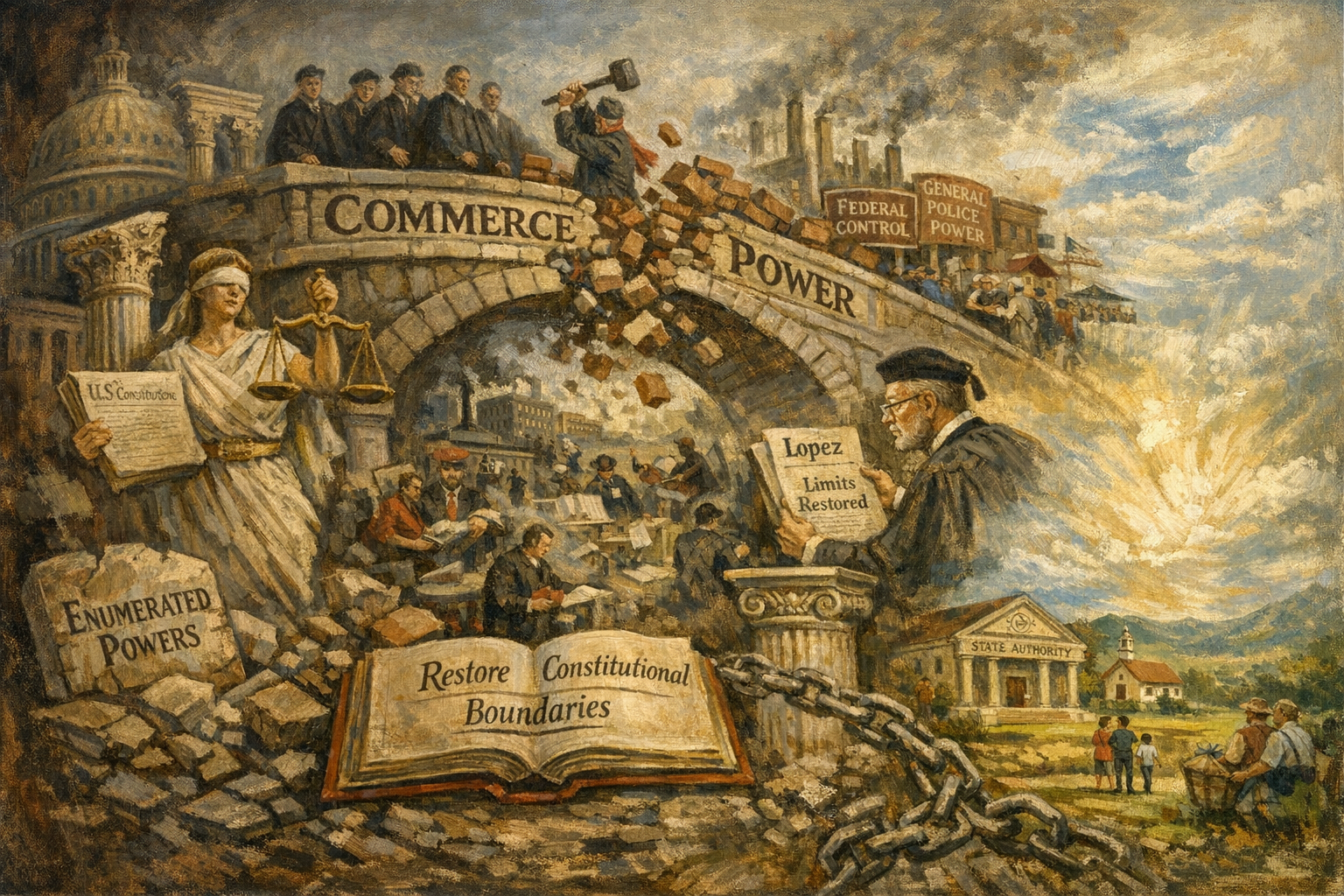
How judicial construction converted an enumerated power into a general police power — and what it would take to fix it
There is a question that sits at the centre of American constitutional law, and almost nobody wants to answer it honestly. The question is this: Is there anything Congress cannot regulate under the Commerce Clause?
Not in theory. Not as a matter of rhetoric. In practice — under the doctrinal machinery courts actually apply — is there a domain of human life that the federal government categorically cannot reach by invoking its power to "regulate Commerce . . . among the several States"?
The honest answer, for anyone willing to trace the logic rather than recite the slogans, is no. There is no such domain. Modern Commerce Clause doctrine supplies Congress with a jurisdictional method that can reach virtually any subject. The method is simple, repeatable, and almost impossible to defeat in court: define a national market, describe local conduct as part of an economic "class," aggregate its effects, and then defend the statute under rational-basis review or as necessary to a comprehensive regulatory scheme.
That method does not merely make the Commerce Clause broad. It makes the Commerce Clause boundless — which is a different thing entirely. A broad power operates within a category. A boundless power has no category. And a Constitution that enumerates powers but enforces no boundary between them and the residuum reserved to the states is not functioning as law. It is functioning as decoration.
The architecture is supposed to constrain
Start with the structural premise, because everything else follows from it.
The Constitution does not grant Congress a general power to govern for the common good and then list a few illustrative competencies. It grants specific powers and withholds the rest. The residuum is reserved to the states and the people. That is not aspirational language. It is the architecture of federal authority. It is the mechanism by which the Constitution denies the national government a general police power.
Commerce is one enumerated power among others. If that power is construed so that it can reach all matters of social life, enumeration becomes meaningless. The Constitution would then describe a government of limited powers while, in operation, authorising a government of plenary competence. That is not an interpretive adjustment at the margin. It is a change of regime.
The Court frequently recites that the federal government possesses only limited, enumerated powers. But the relevant question is not whether the Court utters the phrase. The relevant question is functional: does the doctrine actually prevent Congress from doing what a police power would enable? If Congress can regulate internal matters whenever it plausibly asserts that those matters affect interstate markets, then Congress has acquired a general police power in substance. The constitutional label becomes cosmetic.
And enumeration is not self-executing. If Congress has incentives to expand its competence — and it manifestly does — then a meaningful system of limited powers depends on judicial enforcement. A judiciary that treats the scope of federal power as a matter of legislative discretion does not preserve federalism. It preserves only the vocabulary of federalism.
"Commerce" is a category, not an effects test
The modern doctrine often defends itself by sliding between two claims that must be kept distinct. The first is semantic: "commerce" could mean something broader than narrow buying and selling. The second is jurisdictional: therefore Congress may regulate non-commercial intrastate conduct whenever, in the aggregate, it affects a national market.
Even if one concedes the broader semantic range — and there are serious originalist scholars on both sides of that question — the concession does not yield the modern doctrinal apparatus. A broad category remains a category. It still has an object. Even if "commerce among the several States" encompasses interstate intercourse, navigation, communications, and practical cross-border dealings, the power remains a power over interstate relations. It does not become a power over internal conditions of life merely because internal conditions produce downstream consequences for interstate relations.
Effects logic is not a meaning-based inference. It is a jurisdictional technique. It is the decision to treat what is not commerce as commerce because it influences commerce. That is where the constitutional architecture changes. The Clause's object converts from commerce among the states to whatever affects commerce among the states. And once that conversion is permitted, the enumeration ceases to constrain — because every subject can be redescribed as affecting commerce.
Chief Justice Marshall understood this in Gibbons v. Ogden. He described commerce as "intercourse" and treated navigation as included. That supports breadth within the commercial category. But Marshall also located the limit in the constitutional text: commerce "among" the states is not commerce "completely internal" to a state. His opinion presupposes that there exists an internal domain that remains internal even when it touches economic life. A bounded category can be broad. An unbounded effects test is not a category at all.
How the New Deal changed the logic of power
The New Deal period did not merely expand the scope of federal regulation. It altered the mode of constitutional reasoning by which federal power was justified.
Before the New Deal, the Commerce Clause was understood as authorising regulation of a category of activity — interstate trade and its instrumental incidents. After the New Deal, the Clause increasingly functioned as a justification for regulating whatever activities Congress deemed economically significant in the aggregate. The shift was not announced as a repudiation of enumeration. It was achieved through doctrinal changes that preserved the language of limits while altering their content.
NLRB v. Jones & Laughlin Steel Corp. marks the pivot. The Court upheld federal regulation of labour relations at a large steel manufacturer not because labour relations were commerce, but because labour disputes might burden interstate commerce. The object of regulation ceased to be commerce itself and became whatever activities Congress believed sufficiently connected to commerce by causal chain. The phrase "close and substantial relation" sounded reassuring. But it concealed two elastic variables — what counts as a "relation" and what counts as "substantial" — that would prove impossible to confine.
More important than the holding was the methodological choice. Earlier cases treated the scope of commerce as a legal question courts must answer. Jones & Laughlin began treating it as a factual question Congress could largely answer for itself. Once the judiciary's role becomes confirmatory rather than adjudicative, enumeration loses its constraining force.
Then came Wickard v. Filburn, and the transformation was complete. Roscoe Filburn grew wheat beyond his federal quota for personal consumption on his own farm. The Court upheld the regulation by reasoning that although Filburn's individual activity was trivial, similar conduct by many farmers would substantially affect interstate wheat markets.
Two features are constitutionally decisive. First, the regulated conduct was not commerce among the states. It was production for personal use — an activity traditionally understood as internal and local. Second, federal power was justified not by the nature of the activity but by its aggregation with hypothetical similar acts nationwide.
Aggregation changed the logic of the commerce power. Under aggregation, an individual's conduct becomes constitutionally relevant not because of what it is, but because of what it resembles. Jurisdiction turns not on the object of regulation, but on membership in a class whose collective behaviour Congress predicts will influence a market.
And the stopping point disappears. Every form of production reduces demand elsewhere. Every act of consumption influences prices. Every personal choice has economic reverberations. Aggregation converts the Commerce Clause from a power over trade into a power over life, mediated through economic description.
The bridge nobody talks about
The standard narrative jumps from Wickard to United States v. Lopez — from 1942 to 1995 — as if the intervening decades were mere application. That jump is misleading, and it obscures the most important part of the story.
Between Wickard and Lopez, the Warren and Burger Courts normalised effects reasoning across domains that made Wickard feel ordinary rather than exceptional. The civil-rights cases were the indispensable bridge. Heart of Atlanta Motel upheld Title II of the Civil Rights Act as applied to a local motel, treating congressional findings about the economic consequences of discrimination as sufficient to justify federal authority. Katzenbach v. McClung went further, sustaining Title II as applied to a local restaurant whose customers were predominantly local, on the theory that discrimination by restaurants, in the aggregate, burdened interstate commerce.
Whatever one thinks of the moral necessity of those outcomes — and they were morally necessary — the doctrinal effect was transformative. They entrenched three propositions that later Commerce Clause doctrine would treat as routine: Congress may regulate intrastate conduct that is not itself commerce if it can be tied to an interstate market; the Court will accept congressional findings regarding aggregate effects; and the existence of a comprehensive national objective can justify expansive coverage of local conduct.
After 1964, effects reasoning acquired a kind of moral and institutional legitimacy that made it extremely difficult for courts to treat it as a constitutional problem. And the method became portable. What began as deference in a setting of moral urgency became the default standard in ordinary cases.
Perez v. United States extended the method to criminal law — purely intrastate loan-sharking upheld because Congress found the class of extortionate credit transactions affected interstate commerce in the aggregate. The Court was no longer defending a particular wartime programme or an agricultural price regime. It was applying the same justificatory logic as a regular method in ordinary governance.
By the time Lopez arrived, the problem was not that the Court lacked awareness of the danger. The problem was that the Court had already embraced the machinery that produces boundlessness. For decades it had sustained federal statutes by defining the regulated class broadly, accepting aggregate-effects reasoning, and deferring to Congress's conclusion that effects were substantial.
Lopez announced limits. The machinery ignored them.
Lopez invalidated the Gun-Free School Zones Act and announced the now-canonical taxonomy: Congress may regulate the channels of interstate commerce, the instrumentalities of interstate commerce, and activities that substantially affect interstate commerce. That sounds like structure. But the third category is different in kind from the first two. It is not defined by object but by effect. And once aggregation and deference are available, the third category tends to swallow everything else.
Lopez did not repudiate aggregation. It did not reject rational-basis deference. It did not define "economic activity" in a way capable of consistent application. Instead, it invalidated a statute that lacked the features modern doctrine treats as jurisdictional signals — commercial framing, market context, a jurisdictional element. Congress took the hint. It learned that statutes should include findings, should be tied linguistically to commerce, and should include jurisdictional phrases that allow prosecutors to assert a commerce nexus case-by-case. None of these devices supplies a real limit. Each is a means of avoiding one.
United States v. Morrison briefly glimmered with a genuine principle — non-economic activity cannot be federalised merely by aggregating downstream costs. But Gonzales v. Raich contained Morrison to a narrow corner. In Raich, the Court upheld federal regulation of locally cultivated marijuana authorised by state law, treating the Controlled Substances Act as a "comprehensive scheme" that could reach non-commercial local conduct to prevent leakage into interstate markets.
Raich is the case that makes "no limiting principle" a legal diagnosis rather than a political complaint. Under Raich, a statute need not regulate interstate exchange directly. It need only be framed as part of a comprehensive scheme directed at an interstate market, and the regulated intrastate conduct need only be described as part of a class whose aggregate effects could undermine the scheme. If that suffices, the limiting principle is not constitutional meaning but legislative framing. The Commerce Clause becomes a general warrant for market governance, and the Necessary and Proper Clause becomes an escape hatch for reaching internal conduct whenever Congress asserts that internal regulation makes national regulation more effective.
NFIB v. Sebelius admitted one narrow limit — Congress cannot compel people to enter markets — then upheld the individual mandate under the taxing power anyway. The commerce holding became a caution, not a constraint. And the everyday machinery of expansion remained entirely intact.
What would a real limit look like?
A meaningful limiting principle must do two things simultaneously: re-tether "substantial effects" to commerce as exchange rather than to the economy as a whole, and re-centre the Necessary and Proper Clause on "proper" so that comprehensive-scheme arguments cannot be used to displace state police power by enforcement convenience.
The word "proper" is not surplusage. It performs independent work by requiring that federal means remain consistent with the Constitution's structural commitments, including federalism. A measure may be useful to a regulatory programme — even necessary in the broad McCulloch sense — and yet be improper because it changes the constitutional allocation of authority by converting a limited national power into a general authority to regulate internal life.
Here is an administrable two-step rule.
Step One: Identify the regulated object. Is Congress regulating interstate trade and exchange? The channels and instrumentalities of interstate commerce? A commercial transaction within an interstate market? If the regulated conduct is not exchange-like, not channel or instrumentality use, and not a commercial transaction within an interstate market, the analysis ends. Courts do not substitute an "economic consequences" inquiry for the constitutional object named in the Clause.
Step Two: When incidental reach is claimed under the Necessary and Proper Clause, enforce "proper." Is the regulated intrastate conduct itself commercial? Would excluding it defeat regulation of the interstate market as an interstate market — or would exclusion merely make enforcement more convenient? A claim of administrative difficulty is never sufficient by itself. The question is not whether the measure is useful, but whether it is of a kind compatible with the constitutional division between national commercial regulation and state police power.
This framework does not require resurrecting pre–New Deal formalism. It permits robust national regulation of interstate exchange, its channels, and its instrumentalities. It also permits incidental regulation where intrastate commercial conduct is genuinely part of an interstate market and exclusion would defeat market regulation as such. What it forbids is jurisdiction-by-redescription: treating internal life as federal because it can be aggregated into an effects narrative and then insulated by deference.
Apply this across domains, and the results are disciplined rather than destructive. Federal statutes targeting interstate drug trafficking, interstate firearms sales, and interstate pollution survive easily — they regulate commerce as commerce. Federal criminal statutes that federalise ordinary possession on a "once moved in commerce" theory face hard questions, because they target internal conduct and attach a commerce adjective to the object. Environmental law is strongest where it targets interstate channels and interstate pollution flows, weakest where it functions as land-use permitting justified by chain-of-effects reasoning. And federal regulation of education, family life, and ordinary local crime fails outright — exactly as Lopez and Morrison correctly held.
The transition objection is remedial, not jurisdictional
The most common practical objection is that a real limit would unsettle too much existing law. That concern is understandable. It is also constitutionally irrelevant to the existence of federal power. A law is not constitutional because it is popular, longstanding, or embedded in administrative practice. It is constitutional only if it falls within an enumerated power as properly construed.
The "too much law" objection confuses validity with disruption. Disruption belongs to the remedial stage. Courts have tools to manage it: severability, narrowing constructions, as-applied adjudication, calibrated retroactivity posture. The availability of those tools is precisely why the objection fails as a jurisdictional argument. Transition management is the judicial task after unconstitutionality is identified; it is not a reason to deny unconstitutionality.
Nor does the integrated character of the modern economy supply the missing limit. Integration explains why interstate trade regulation must be effective. It does not justify converting the commerce power into a general power to regulate welfare by economic description. To treat integration as a reason to dissolve limits is to build into the Constitution a self-destruct mechanism: the more complex society becomes, the less binding enumeration is permitted to be. Nothing in the text, structure, or logic of limited government supports that proposition.
And the political-safeguards argument — that the national political process protects federalism without judicial enforcement — confuses invited overlap with compulsory overlap. When Congress structures cooperative programmes that states administer and negotiate, that is political design within legal constraints. When Congress asserts that it may regulate internal conduct as such because internal conduct, in the aggregate, affects an interstate market, that is a jurisdictional claim that converts state police power into federal competence by the method of economic description. Political safeguards may sometimes temper the use of that method. But political tempering is not a constitutional boundary. It is discretionary restraint — and discretionary restraint is least reliable precisely in the contexts where the commerce hook has been most aggressively used: federal criminal law, moralised national panics, and symbolic politics.
The honest question
The Commerce Clause can be broad within its domain and bounded at its edge. That is not an antiquarian project. It is what enumeration requires if the Constitution is to function as law.
The alternative is not merely an expansive national government. It is a system in which constitutional boundary questions are resolved by legislative characterisation and judicial plausibility review — a system where the scope of federal power depends not on what the Constitution authorises, but on how creatively Congress can narrate a market connection.
If the Court is unwilling to administer limits, it will continue to announce them episodically while permitting the operative method to dissolve them. If, instead, it restores a meaning-based commerce category and treats propriety as a real constraint on incidental means, it can preserve robust national authority over interstate markets without allowing the commerce power to operate as a general police power in practice.
The question is not whether limits should exist.
Even the modern Court says they should. The question is whether anyone is willing to enforce them.