The Jury Is Not a Fact-Finding Machine. It Never Was.
Britain is dismantling jury trials to clear court backlogs. America has already sidelined them through plea bargaining. Both countries are making the same constitutional mistake—and the consequences go far deeper than procedure.
 The Constitutional Observer
14 min read
The Constitutional Observer
14 min read
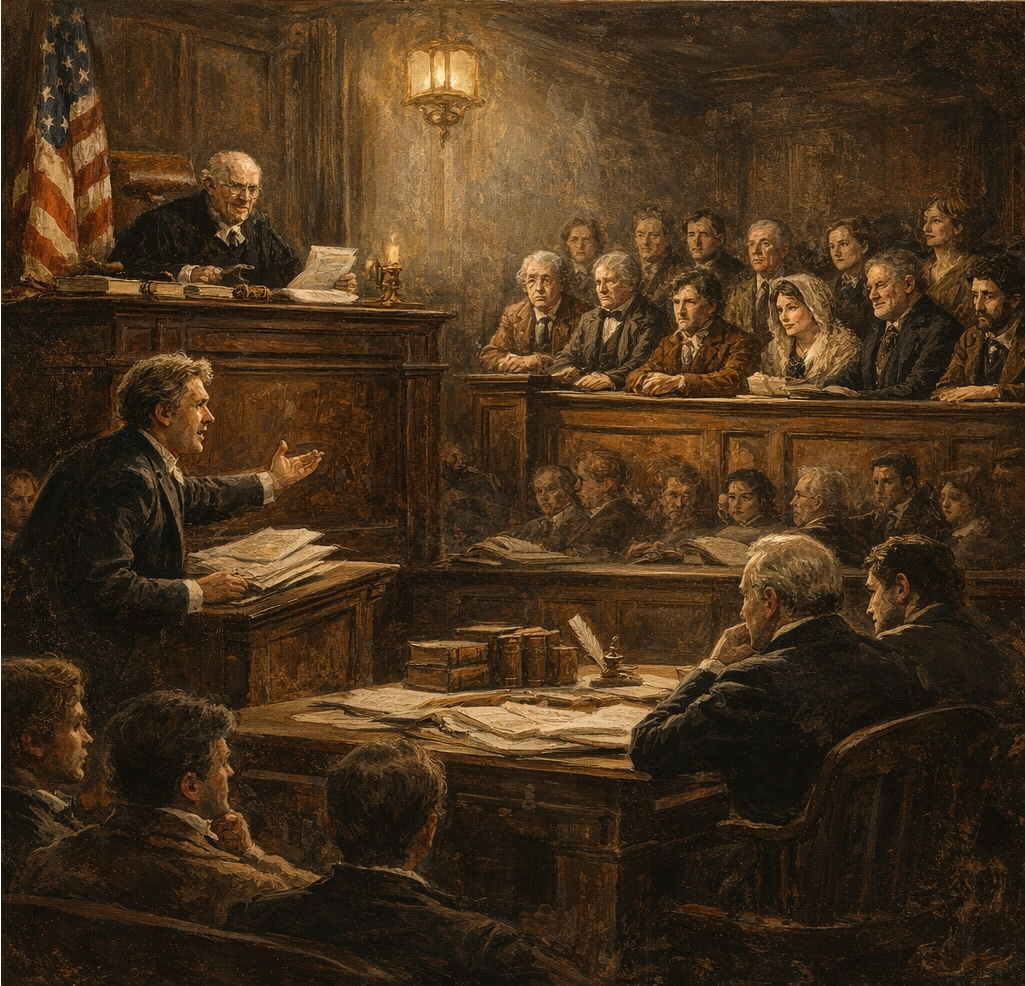
There is a line about juries that you encounter everywhere in legal commentary: juries determine facts; judges determine law. It sounds clean, sensible, and modern. It traces to the Supreme Court's 1895 decision in Sparf v. United States, and it has become the default framing for anyone who wants to explain what a jury does. The problem is that the line is not a description. It is an aspiration—and a misleading one. It takes the jury, one of the oldest and most structurally important institutions in the Anglo-American constitutional order, and repackages it as a cognitive tool. A group of twelve people tasked with sorting true from false, signal from noise, and then going home.
That is not what the jury is. It has never been what the jury is. The jury is a legitimacy mechanism. It is the institution through which citizens authorise the state's most extreme acts—imprisonment, dispossession, the destruction of a person's civic life—and without which criminal law becomes something different in kind: not law constrained by the people, but administration constrained only by officials.
This distinction matters now more than it has in decades, because the jury is under coordinated pressure on both sides of the Atlantic. In Britain, the government is openly proposing to curtail jury trials for broad categories of criminal offences, citing crushing court backlogs as justification. In the United States, the jury right remains constitutionally enshrined but has been functionally marginalised by the dominance of plea bargaining—a system the Supreme Court itself has described, with unusual candour, as "for the most part a system of pleas, not a system of trials."
Different mechanisms. Same destination. And the destination is one that should alarm anyone who takes seriously the idea that criminal punishment requires democratic authorisation.
The Jury Was Built to Check Power, Not Weigh Evidence
The modern "facts only" account treats the jury as a recent invention of procedural rationality. Historically, it was something far more dangerous: a buffer between the individual and the state.
The canonical moment is Bushell's Case, decided in 1670. William Penn and William Mead were prosecuted for preaching to an unlawful assembly. The jury refused to convict. The judge, furious, fined and imprisoned the jurors. Edward Bushell, one of the holdouts, sought habeas relief—and won. The principle that emerged was foundational: jurors cannot be coerced or punished for the verdict they return.
This is not a housekeeping rule about deliberation protocol. It is a constitutional settlement in embryo. The state may prosecute, but it cannot compel condemnation. The jury is not an arm of the court. It is an independent institution whose judgment the court must accept, even when it disagrees.
The principle did not develop in isolation. Throughout the seventeenth and eighteenth centuries, English juries repeatedly served as the institution that checked prosecutorial abuse and politically motivated charges. Jurors acquitted publishers charged with seditious libel. They refused to convict under laws they regarded as instruments of religious or political persecution. The jury was not understood as a neutral processor of evidence. It was understood as the last line of defence against a government that might use the machinery of criminal law to punish its critics and suppress dissent.
That settlement travelled to America and became more explicit. The Sixth Amendment constitutionalised the criminal jury right. The Seventh preserved the civil jury in suits at common law. The Framers were not simply codifying a procedural preference. They were embedding a structural principle: criminal punishment must not become a purely professionalised state output. The citizen must stand between the accusation and the punishment. The colonial experience had made the point vivid: British authorities had attempted to use vice-admiralty courts—tribunals without juries—to prosecute smuggling and customs violations, precisely because local juries could not be trusted to convict their neighbours under laws the colonists regarded as unjust. The jury was thus linked, from the Republic's founding, to the principle of self-governance in its most concrete form.
Even early American practice preserved the older, more radical understanding. Chief Justice Jay's jury instructions in Georgia v. Brailsford in 1794 reflect the transitional moment perfectly. He states the "good old rule" that juries decide fact and courts decide law—and then immediately adds that juries have the right to determine both. The modern legal establishment prefers to remember the first half of that sentence and forget the second.
There is also a dimension that the standard historical account often sanitises: race. The jury's composition has always been inseparable from its legitimacy. When the Supreme Court held in Strauder v. West Virginia in 1880 that excluding Black citizens from jury service violated the Equal Protection Clause, it was recognising something deeper than procedural fairness. A jury drawn exclusively from one racial group pronouncing judgment on members of another is not merely biased—it fails the democratic authorisation test entirely. The condemnation of a citizen by a body from which people like that citizen have been systematically excluded is not citizen authorisation. It is caste administration wearing constitutional clothing.
The jury is not an arm of the court. It is an independent institution whose judgment the court must accept, even when it disagrees.
Why "Facts" Cannot Be Separated from Law—and Why That Matters
The Supreme Court has described the criminal jury right as "fundamental to the American scheme of justice." That language, from Duncan v. Louisiana in 1968, is usually treated as rhetorical embroidery. It should be read as a structural claim: a criminal conviction is not merely a correct finding of wrongdoing. It is a lawful act of the state that requires a particular form of authorisation.
The inseparability of fact and law becomes obvious once you look at how criminal cases actually work. Consider mens rea—the mental state required for a crime. Was the defendant's killing "purposeful" or "reckless"? That is supposedly a fact question. But the distinction between purpose and recklessness is a legal construct. The juror who decides the defendant acted "recklessly" rather than "purposely" is not merely reporting an observation about the world. She is applying a legal category that determines whether the defendant faces a murder charge or a manslaughter charge—a difference, potentially, of decades of imprisonment.
Or consider affirmative defences. When a jury decides that the defendant acted in self-defence, it is not finding a "fact" in any ordinary sense. It is making a normative judgment about what counts as reasonable force under the circumstances. The "reasonable person" standard that pervades criminal law is not a factual benchmark. It is a moral and social judgment that the jury is uniquely positioned to make precisely because it is drawn from the community.
The modern sentencing cases make this structural point impossible to ignore. In Apprendi v. New Jersey, the Supreme Court held that any fact increasing a defendant's punishment beyond the statutory maximum must be submitted to the jury and proved beyond a reasonable doubt. Blakely v. Washington extended the principle to sentencing guidelines. United States v. Booker applied it to the federal guidelines. The doctrinal label is "sentencing," but the constitutional logic is jurisdictional. If a factual finding changes the range of lawful punishment, that finding is part of what makes punishment lawful. The jury does not merely evaluate evidence here. It determines the boundaries of state power.
A system that allows officials to reallocate those boundary-setting determinations from citizens to professionals is not changing procedure. It is reallocating constitutional authority.
The Veto the System Depends On but Refuses to Name
Sparf v. United States, the case that gave us the "facts only" slogan, insists that the law in criminal cases "is to be determined by the court." Juries must not "make" law. But Sparf simultaneously acknowledges the qualification that destabilises its entire account: acquittals are final.
A not-guilty verdict ends the matter. The prosecution cannot appeal. The jury cannot be hauled back to explain its reasoning. This is not a procedural technicality. It is the design. When you combine the general verdict (guilty or not guilty, with no requirement to explain), the finality of acquittal, and the no-impeachment rule (which prevents inquiry into jury deliberations), you get a system that contains an irreducible citizen veto over the application of criminal law.
The system depends on this veto. It relies on the possibility that juries will refuse to convict when the law, however technically applicable, produces results that the community regards as unjust. But the system will not say so out loud.
The D.C. Circuit's decision in United States v. Dougherty is the emblematic statement of this paradox. The court recognises that juries have the power to acquit against the evidence and instructions. It then holds that courts need not—and generally should not—tell jurors that this power exists. The legal system maintains the veto while treating its explicit articulation as dangerous.
This is not hypocrisy, exactly. It is a structural feature of a system that needs the jury to function as a boundary without formally acknowledging it as one. If juries were told they could nullify, the argument goes, they might do so irresponsibly. But if the power were actually removed—if acquittals could be appealed, if jurors could be punished for "wrong" verdicts—the system would lose its most fundamental check on prosecutorial and legislative overreach.
Juries are told they do not judge law. But they hold the only unreviewable power in the entire criminal process.
The debate over jury nullification has never been politically neutral. When Paul Butler argued in the Yale Law Journal that Black jurors should consider nullification as a response to the racially disproportionate impact of drug laws, the proposal was treated as incendiary. But Butler's argument exposes the deeper tension: a system that relies on the jury's unreviewable veto as a safety valve cannot coherently object when the communities most affected by criminal enforcement use that same veto to register dissent. The system wants the check without the politics. That has never been possible.
Britain's Warning: When Efficiency Becomes a Theory of Legitimacy
The British constitution is famously unwritten in a single text. Jury trial is not entrenched the way the Sixth Amendment entrenches it in the United States. It is sustained through statutes—principally the Juries Act 1974—institutional arrangements, and political tradition.
That difference matters now, because Britain is actively debating and implementing reductions in jury trial. The court backlogs in England and Wales are severe. Cases wait years to be heard. Courtrooms are physically deteriorating. Victims and defendants alike are trapped in a system that cannot process its own workload. The pressure to find efficiencies is genuine and understandable.
But the proposed solutions involve shifting large categories of cases away from jury trial into judge-only or summary proceedings. The Leveson Review and subsequent government proposals have floated expanding the jurisdiction of magistrates' courts, increasing the range of offences triable without a jury, and creating streamlined adjudication pathways that bypass the Crown Court entirely. The rhetoric is managerial: faster resolution, reduced costs, better resource allocation. The constitutional substance is different. When you move categories of criminal cases from juries to professional adjudicators, you are not merely changing the method of determination. You are changing who authorises condemnation.
The danger is not primarily about accuracy. Professional judges may well be more consistent fact-finders than juries in many cases. The deeper danger is the redefinition of legitimacy itself. Once judge-only adjudication becomes the default for broad categories of criminal accusation, the citizen's role in criminal condemnation is recast as exceptional—a luxury reserved for the most serious cases—and officialdom becomes the normal source of guilt.
That is a change in the constitutional ecology of punishment, even if Parliament can accomplish it by ordinary legislation. Britain already processes the vast majority of its criminal cases through magistrates' courts, where lay or professional magistrates adjudicate without juries. What is now being proposed is an expansion of that model into territory—either-way and even some indictable offences—that has traditionally been the province of the Crown Court and the jury.
There is an additional dimension that illuminates the limits of the "efficiency" framing. The European Convention on Human Rights, incorporated into British domestic law by the Human Rights Act 1998, guarantees the right to a fair trial under Article 6. But Article 6 does not specifically require trial by jury. The Strasbourg Court has consistently held that the fair trial guarantee can be satisfied by professional judges sitting alone, provided the proceedings are independent, impartial, and procedurally adequate.
This gap in international human rights law is revealing. It demonstrates that the jury right is a distinctive feature of the Anglo-American tradition rather than a universal requirement of fair procedure. But the fact that Article 6 permits the removal of juries does not mean the removal is constitutionally costless. Some costs are not captured by human rights frameworks, because they concern not the fairness of individual proceedings but the democratic character of the system as a whole.
America's Quieter Retreat: The Trial Penalty
The United States has not needed a parliamentary announcement to sideline its juries. The functional replacement has been operating for decades, and it operates through incentive rather than legislation. It is called plea bargaining.
The numbers are extraordinary. In Lafler v. Cooper, the Supreme Court stated the reality plainly: ninety-seven percent of federal convictions and ninety-four percent of state convictions result from guilty pleas. These are not statistics from the margins of the system. They are the system. The criminal jury trial, constitutionally guaranteed, has become a statistical anomaly.
It is worth pausing on that figure. If you are charged with a federal crime in the United States today, there is a ninety-seven percent chance that your case will never see a jury. Your guilt or innocence will never be debated in open court. No group of citizens will hear the evidence, weigh the credibility of witnesses, apply the law to the facts, and render a verdict in your case. Instead, your fate will be determined in a negotiation between your lawyer and a prosecutor, subject to judicial approval that is, in the vast majority of cases, perfunctory. The constitutional right to a jury trial—the right the Framers considered so fundamental that they enshrined it in both the body of the Constitution and the Bill of Rights—will have no practical application to your case whatsoever.
How did this happen? Not through any formal curtailment of the right. The Sixth Amendment is intact. Any defendant can demand a jury trial. The mechanism is subtler and, in some ways, more effective than legislative repeal. It is the trial penalty.
The trial penalty is the well-documented disparity between the sentence a defendant receives after pleading guilty and the sentence the same defendant would receive after conviction at trial. Studies consistently find that post-trial sentences are three to four times longer than post-plea sentences for comparable offences. Prosecutors can stack charges, threaten mandatory minimums, and structure plea offers so that the rational calculation overwhelmingly favours acceptance. A defendant who insists on her constitutional right to a jury trial is not merely risking an adverse verdict. She is risking a sentence designed to punish the exercise of the right itself.
The result is a system where the jury right is formally preserved and functionally nullified. The Constitution guarantees every criminal defendant the right to have her guilt determined by a body of citizens. The system then creates conditions under which exercising that right is economically irrational for the overwhelming majority of defendants.
Ninety-seven percent of federal convictions come from guilty pleas. The jury trial is constitutionally guaranteed and statistically extinct.
The innocence problem makes this structural coercion especially alarming. The Innocence Project and similar organisations have documented hundreds of cases in which defendants who pleaded guilty were later exonerated. These are not cases where the system worked as designed and produced an unfortunate outcome. They are cases where innocent people, confronted with the mathematics of the trial penalty, concluded that accepting punishment for crimes they did not commit was preferable to the catastrophic risk of conviction at trial.
When an innocent person pleads guilty because the cost of exercising her constitutional right to a jury trial is too high, the constitutional function of the jury has not merely been underutilised. It has been inverted. Instead of the state proving guilt to citizens before punishment can occur, citizens are induced to authorise their own punishment as the price of avoiding worse. The state still calls this "law," because a judge accepts the plea and enters judgment. But the constitutional function—public authorisation of condemnation—has been structurally bypassed.
Defence counsel face an impossible position. An attorney who advises a client to reject a plea offer and go to trial, knowing that conviction would result in a dramatically longer sentence, may be acting on constitutional principle but counselling against the client's practical interest. An attorney who advises acceptance of the plea may be protecting the client's immediate welfare while facilitating the system's circumvention of the jury right. The ethical bind is not a failure of individual attorneys. It is a structural feature of a system that has made the constitutional right to trial practically irrational to exercise.
The Same Destination, Two Different Roads
Britain's open debate about limiting juries and America's plea-driven displacement are usually discussed as separate phenomena. They are not. They are two expressions of the same structural tendency: the professionalisation of condemnation.
In Britain, the mechanism is legislative. Parliament has the power to redefine which offences are triable by jury, and it is exercising that power under the pressure of institutional crisis. The arguments are framed in terms of administrative necessity. The constitutional implications are treated as secondary.
In America, the mechanism is prosecutorial. The charging power, combined with mandatory minimums and sentencing guidelines, gives prosecutors the ability to structure incentives so that jury trials become prohibitively expensive for defendants. No legislation is required. The constitutional right remains on the books. It simply ceases to be exercised.
Both roads lead to the same place: a criminal justice system where condemnation is overwhelmingly produced by professionals—prosecutors and judges—rather than authorised by citizens. The jury becomes ceremonial. It exists in the statute books and the constitutional text, available in theory to anyone who wants it, exercised in practice by almost no one.
That transformation matters because it changes what criminal law is. Criminal law that routinely requires citizen authorisation before the state may punish is a different kind of institution from criminal law that operates as a bureaucratic process with judicial oversight. The first is a system of democratic accountability, however imperfect. The second is administration.
What the Jury Actually Provides
The most seductive mistake in modern discussion is to treat the jury as an optional feature that can be traded against administrative needs. That mistake arises from describing the jury as a fact-finding instrument rather than what it actually is: the state's legitimacy filter.
A legal system can be accurate and still be illegitimate. Imagine a system with excellent judges, well-trained prosecutors, rigorous procedures, and no citizen participation whatsoever in the determination of guilt. Such a system might produce correct outcomes at a high rate. It would still be missing something fundamental: the principle that the state's most extreme exercises of power require authorisation from the governed.
That is what the jury supplies when it is real rather than ceremonial. Not superior fact-finding—juries are sometimes worse at finding facts than professionals. Not efficiency—juries are expensive and slow. What the jury supplies is the democratic form of condemnation. It is the institution that prevents criminal punishment from being solely an official act.
This is why the common formulation—"juries should not replace law with what they think law should be"—misses the point. The jury's purpose is not to legislate. The jury's purpose is to ensure that punishment cannot occur without the participation of the people in whose name it is imposed. Even the doctrine that denies juries the status of "judges of law" cannot remove the structural veto created by the general verdict and the finality of acquittal—a veto that Sparf itself acknowledged even as it tried to contain it.
When juries cease to be the normal condition of conviction—whether because a legislature has removed them or because a plea system has priced them out of reach—criminal law becomes administrative power with judicial paperwork. The state does not merely enforce law. It becomes the primary author of condemnation, unchecked by the citizens in whose name it claims to act.
Britain's present curtailment proposals show how quickly the state will reframe the jury as "inefficient" when under pressure. America's plea-driven system shows that the same reframe can occur without any legislation at all, through incentives that make the constitutional right to trial economically irrational for most defendants.
The constitutional claim is ultimately simple. The jury is not decoration. It is not a quaint inheritance from an earlier era of legal thinking. It is the mechanism through which the governed participate in the state's most coercive function. When that mechanism is displaced—by statute in Britain, by prosecutorial leverage in the United States—what remains may still be called criminal justice. But it will have lost the feature that made it justice rather than administration: the requirement that the people, and not only the officials, must say guilty before the state may condemn.
A system that wants both legitimacy and efficiency must resist the temptation to treat citizen authorisation as an indulgence that can be sacrificed when resources are scarce. Juries are not there to optimise throughput. They are there to ensure that "law" does not become whatever the state can process.
That is the principle. Britain is testing how far a modern state will go in forgetting it. America, in its own way, has already answered the question.
The response to both challenges must begin with a refusal to accept the framing that treats the jury as a luxury. Efficiency arguments have their place, but they cannot be permitted to override the structural question of who authorises the state's punitive acts. In Britain, this means recognising that the court backlog crisis, however real, cannot be solved by sacrificing the institution that gives criminal condemnation its democratic character. Investment in court infrastructure, judicial appointments, and case management can reduce backlogs without eliminating the citizen from the process. In the United States, it means confronting the trial penalty directly—through sentencing reform, prosecutorial guidelines, and judicial oversight of plea bargains—so that the constitutional right to a jury trial is not merely available in theory but exercisable in practice.
The jury is imperfect. It is slow, expensive, unpredictable, and sometimes wrong. It is also irreplaceable. No other institution in the Anglo-American legal tradition performs the same function: requiring the state to persuade a body of citizens, drawn from the community, that its accusation warrants condemnation. That function is not a historical relic. It is the difference between criminal law and criminal administration. And it is worth defending, in both countries, before the retreat becomes irreversible.